A short portrait
Anna Maria Calhoun Clemson moved through the 19th century like a private current under public tides — quietly shaping a place and a legacy that would become larger than any single life. Born into one of the South’s most prominent families in 1817, she was at once daughter, manager, wife, and steward: copyist for a powerful father, partner to a worldly husband, and guardian of Fort Hill through war, death, and legal entanglement. Her life arcs across 58 years marked by births and losses, travel and return, property disputes and the germination of an idea that later took institutional form.
Basic information
| Field | Details |
|---|---|
| Full name | Anna Maria Calhoun Clemson |
| Born | February 13, 1817 (Bath plantation, Abbeville District, S.C.) |
| Died | September 22, 1875 (Fort Hill, S.C.) |
| Parents | John Caldwell Calhoun (father); Floride Bonneau Colhoun Calhoun (mother) |
| Spouse | Thomas Green Clemson (married November 13, 1838) |
| Children | Infant daughter (c.1839, died infancy); John Calhoun Clemson (1841–1871); Floride Elizabeth Clemson (1842–1871); Cornelia “Nina” Clemson (1855–1858) |
| Burial | St. Paul’s Episcopal Church Cemetery, Pendleton, S.C. |
| Noted roles | Daughter and assistant to John C. Calhoun; manager of households and estates; early organizer and advocate for an agricultural/scientific college at Fort Hill |
Family map in numbers
| Relation | Name | Lifespan / Note |
|---|---|---|
| Father | John C. Calhoun | 1782–1850 — national statesman |
| Mother | Floride Calhoun | 1792–1866 — plantation matriarch |
| Husband | Thomas G. Clemson | 1807–1888 — diplomat, scientist, benefactor |
| Children | John C. Clemson | 1841–1871 — died in train accident |
| Floride E. Clemson (married Lee) | 1842–1871 — died of tuberculosis | |
| Cornelia “Nina” Clemson | 1855–1858 — died in childhood | |
| Grandchild | Floride Isabella Lee | b. May 15, 1870 — only surviving grandchild at one point |
The arc: timeline of key dates
| Year | Event |
|---|---|
| 1817 | Born February 13 at Bath plantation. |
| c.1835 | Moves to Washington to assist her father as copyist/assistant. |
| 1838 | Marries Thomas Green Clemson on November 13 at Fort Hill. |
| 1839 | First infant daughter born and dies in infancy. |
| 1841 | Son John Calhoun Clemson born. |
| 1842 | Daughter Floride Elizabeth Clemson born (Dec 29). |
| 1844–1852 | Years abroad during Thomas Clemson’s diplomatic posting to Belgium (approx.). |
| 1855 | Daughter Cornelia “Nina” born. |
| 1861–1865 | Civil War era; property management and relocations between Maryland and South Carolina. |
| 1866 | Floride Calhoun (mother) dies July 25. |
| 1870 | Granddaughter Floride Isabella Lee born May 15. |
| 1871 | Daughter Floride dies July 23; son John dies August 10. |
| 1875 | Anna dies September 22 at Fort Hill. |
| 1888 | Thomas Green Clemson dies April 6; his will later establishes an agricultural college. |
Roles and responsibilities — what she actually did
Anna’s public life was muted but essential. She filled several persistent roles during an era when women’s public authority was limited but domestic and documentary labor carried political and economic weight.
- As a young woman she served as copyist and assistant to her father during his national service, handling correspondence and helping maintain the complex paperwork of a leading political household. That administrative work put her at the center of political life — not as the orator or officeholder, but as the institutional memory and steady hand behind the scenes.
- As a diplomat’s wife she lived intermittently in Philadelphia and abroad, but Fort Hill remained the gravitational center. Her management of household affairs — in Philadelphia, Maryland, and at Fort Hill — required acute administrative skills and a capacity to read legal and property complications.
- During the Civil War and its chaotic aftermath she oversaw packing, relocating possessions, and tending family interests. She navigated foreclosures, sales, and intra-family financial maneuvers that often determine whether an estate survives intact or vanishes into claims and debt records.
- Perhaps most lasting was her organizational energy for an agricultural and scientific institution. She promoted the idea, formed committees, and gathered local support for a college that would honor and build from the Fort Hill legacy. That groundwork — she was the persuader-in-waiting — became a seed that her husband’s later legal bequest cultivated.
The shape of grief and responsibility
Numbers can feel clinical: three children lost, two survive to adulthood and then die within weeks of one another in 1871, a single grandchild born in 1870 who became the line’s hope. But beneath the figures is a life of recurring stewardship: a daughter who managed the household when her father’s career took him away; a wife who supported a diplomatic life and then shouldered rebuilding and legal battles when war and death rearranged property lines.
Her long attachment to Fort Hill — the house, the land, the agricultural promise — reads like a quiet insistence. She inherited and held property interests; she fought, in effect, to keep the physical and symbolic heart of her family intact. Those efforts were not merely sentimental. They had real financial and legal consequences: the property’s status and the standing she maintained helped make possible the later bequest that founded a formal college on Fort Hill.
Fort Hill and an idea that grew
Think of Fort Hill as a seedbed: a place that absorbed family memory, plantation economy, and institutional imagination. Anna kept that seedbed tended. She did not live to see the college open in 1893; she did, however, invest energy — political, social, and administrative — into the vision of an agricultural and scientific school. Her husband later translated that vision into a legal instrument, but the idea itself had roots in the conversations, committees, and local advocacy she carried forward.
Portraits, houses, and the afterlife of a name
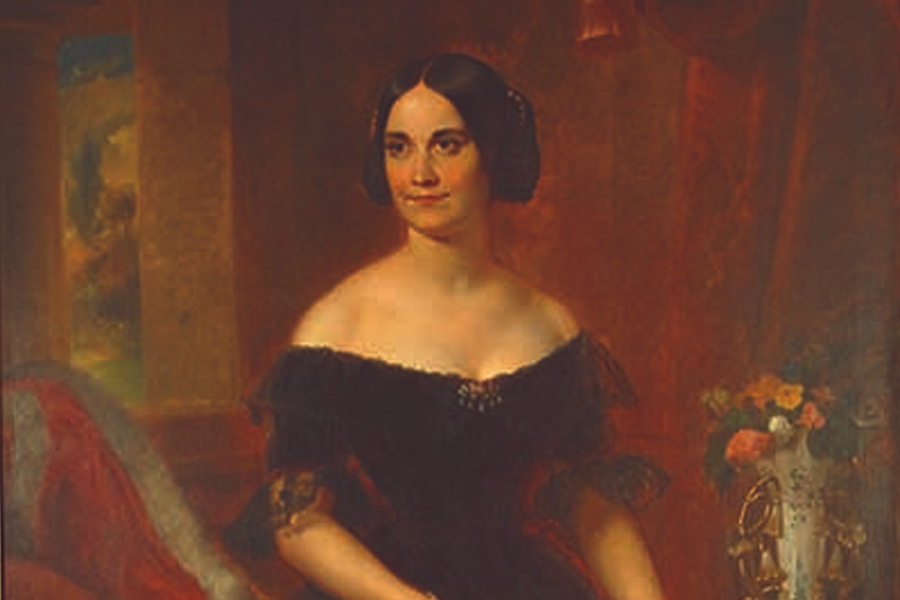
Her likeness, the Fort Hill house, and the persistent family name became anchors for institutional memory. Portraits hang; rooms are shown; the house and land are interpreted as the wellspring for a regional university. That public memory compresses a long private life into emblematic images: a woman in a painted pose, a weathered house, a plaque noting names and dates. The compression hides the messy arithmetic of estate law, grief, and daily management. It also, unavoidably, secures her place in a longer institutional story, where one life becomes a hinge between family history and a public academy.