A Brief, Private Biography
Elena Nikitichna Khrushcheva was born in Moscow in 1937 into one of the most visible families of the Cold War—yet her life moved in the opposite direction of headlines: inward, private, curtailed. She was the youngest child of Nikita Sergeevich Khrushchev, the Soviet leader who steered the USSR through de-Stalinization and the Cuban Missile Crisis, and Nina Petrovna Kukharchuk, a teacher and party activist who later served as the de facto first lady of the Khrushchev household. Elena’s existence is measured in a handful of dates, a few photographs, and family recollections rather than public office or published works; she died in 1972 at age 35, her passing recorded as the result of long-standing poor health. (Wikipedia)
Basic Information
| Field | Detail |
|---|---|
| Full name | Elena Nikitichna Khrushcheva |
| Year of birth | 1937 |
| Year of death | 1972 (aged 34–35) |
| Parents | Nikita S. Khrushchev (father); Nina P. Kukharchuk (mother). |
| Siblings | Sergei Nikitich Khrushchev (b. 1935), Rada Nikitichna (b. 1929), half-siblings and adopted relatives. |
| Education | Reported as a law student at Moscow University in 1959. (TIME) |
| Burial | Novodevichy Cemetery, Moscow. (Find a Grave) |
Family Portrait: Kin, Names, Numbers
The Khrushchev family reads like a small constellation: roots in Ukrainian villages, branches into party schools, engineering institutes, journalism desks, and later into foreign classrooms. Below is a compact tabulation of the immediate family that framed Elena’s life.
| Name | Relation to Elena | Born–Died (years) | Notable roles |
|---|---|---|---|
| Nikita Sergeevich Khrushchev | Father | 1894–1971 | Soviet Party leader (First Secretary 1953–1964) and Premier (1958–1964). (Wikipedia) |
| Nina Petrovna Kukharchuk | Mother | 1900–1984 | Teacher, party activist, accompanied Khrushchev on official visits. (Wikipedia) |
| Rada Nikitichna Adzhubei | Sister (full) | 1929–2016 | Journalist/editor; married to Izvestia editor Aleksei Adzhubei. |
| Sergei Nikitich Khrushchev | Brother (full) | 1935–2020 | Rocket engineer, later academic in the U.S. |
| Leonid Nikitovich Khrushchev | Half-brother | 1917–1943 | Fighter pilot; died in WWII. |
| Yuliya (Julia) | Half-sibling / adopted niece relationship | c. 1915–1981 | Raised within Khrushchev household; cultural life in Kyiv. |
Numbers matter here: three children in the Nina–Nikita union (Rada 1929, Sergei 1935, Elena 1937), one prominently deceased half-brother (Leonid 1917–1943), and a web of adopted and extended kin that blurred conventional family lines in a Soviet milieu where private and political lives overlapped. (Wikipedia)
Education, Daily Life, and the Invisible Career
Reports from the period around 1959 describe Elena as a law student at Moscow University—part of a generation that had unusual access to higher education, yet also the constraints of being under the public eye by association. A short sentence in a contemporary profile published during Nikita Khrushchev’s high-profile tours notes “Lena, 21, is now a law student at Moscow University,” an image of normalcy nested inside global geopolitics. (TIME)
But being a law student did not translate into a visible career. No formal professional appointments, published writings, party posts, or public honors are attributed to Elena in available records. Her adult life—when visible at all—appears domestically framed: photographs of family gatherings, snapshots of children and pets, and references in memoirs and obituaries rather than bylines. The pattern suggests a life constrained by health and the peculiar social architecture of the Soviet elite, where privilege often meant services, housing, and travel, but also intense scrutiny and limited independent public space. (Wikipedia)
Illness, Passing, and Burial
Official Soviet disclosures about private illness were often elliptical; Elena’s death in July 1972 was quietly recorded and later surfaced in Western press notices. Contemporary obituaries noted only that she had died after prolonged ill health; Soviet practice and family preference appear to have minimized public discussion of specific diagnoses. Her grave at Novodevichy, a resting place for many figures of Russian public life, marks her presence in the city’s ledgers even as the particulars of her life remain spare. (Newspapers.com)
A handful of later mentions in medical retrospectives have speculated about specific autoimmune disease involvement, but such claims are not corroborated by formal family statements or official records cited at the time of her death; the responsible path in historical narrative is to note poor health as the proximate description offered contemporaneously. (Newspapers.com)
The Household Around Power: Privilege and Pressure
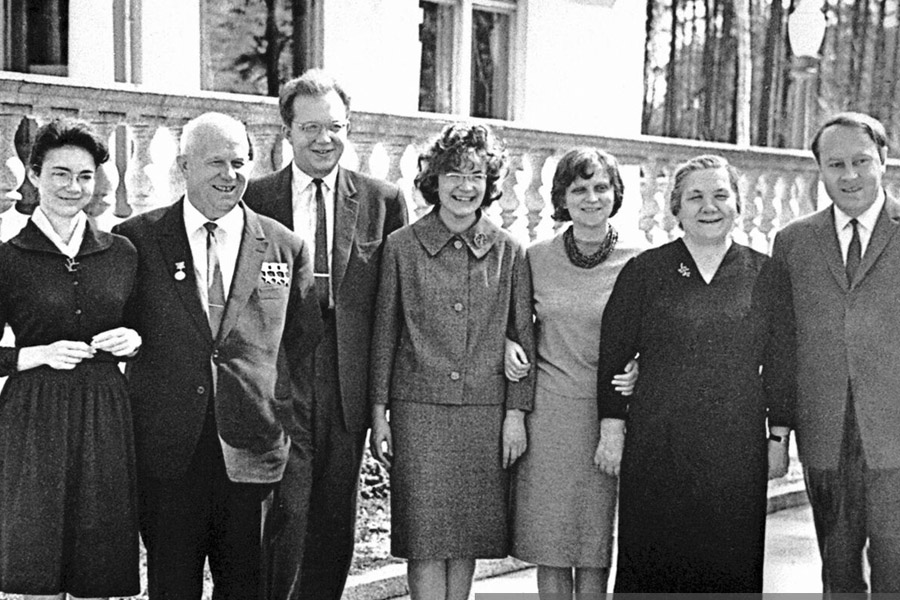
Born in 1937, Elena’s childhood coincided with brutal decades—Stalin’s purges, wartime evacuations, and the postwar ascent of a father whose public acts reshaped Soviet society. Privilege in the Khrushchev household came in the form of dachas, access to the capital’s elite institutions, and a front-row seat at epochal events; it also came with the dampening rain of political turbulence—dismissal in 1964, enforced retreat, and a public life that could be as constricting as it was bright. Family photographs—Khrushchev with a dog, siblings in summer light—offer the texture of ordinary human moments inside an extraordinary household. (Facebook)
An Index of Dates and Moments
| Year | Event |
|---|---|
| 1937 | Elena born in Moscow. (Wikipedia) |
| 1943 | Death of half-brother Leonid in WWII—an event that altered family dynamics. (Wikipedia) |
| 1958 | Family photographs show domestic moments (e.g., Elena with family dog Arbat). (Facebook) |
| 1959 | Noted as studying law at Moscow University. (TIME) |
| 1964 | Nikita Khrushchev ousted from power; family retreats from the public stage. (Wikipedia) |
| 1971 | Death of Nikita Khrushchev. (Wikipedia) |
| July 14, 1972 | Elena dies after protracted illness; obituary notices appear abroad. (Newspapers.com) |
Why the Quietness Persists
The record of Elena Khrushcheva is an absence made visible: a name in a family roster, a law-student footnote, a grave marker in a famous cemetery. The Soviet system often transformed personal medical details into guarded facts; private suffering rarely translated into public chronicle unless it served state narrative. In Elena’s case, the archive leaves us with gestures and dates—photographs frozen like small boats on still water—rather than an open ledger of achievement. Her life reads like a palimpsest where the family’s political script overwhelmed the individual’s marginal lines. (Find a Grave)
Family Afterlives: Descendants and Remembrances
Later generations—scholars, journalists, and public intellectuals in the Khrushchev lineage—have carried forward the family name into new spheres and geographies; some emigrated, some taught, some wrote. These descendants keep pieces of the family memory alive, but Elena herself remains a discreet figure within those recollections: a presence felt mostly through familial notes and the quiet authority of a gravesite. The story of her life, brief and inward, is a reminder that even households that shape history contain people whose stories are themselves partly hidden by the weight of public events. (TIME)
Selected Family Roll (compact)
| Person | Born | Died |
|---|---|---|
| Nikita S. Khrushchev | 1894 | 1971 |
| Nina P. Kukharchuk | 1900 | 1984 |
| Rada N. Adzhubei | 1929 | 2016 |
| Sergei N. Khrushchev | 1935 | 2020 |
| Elena N. Khrushcheva | 1937 | 1972 |
| Leonid N. Khrushchev | 1917 | 1943 |
A family can be a prism and a cage; Elena Khrushcheva’s life refracts familiar colors but keeps its interior shades largely private, like a window slightly curtained against a bright world. (Wikipedia)