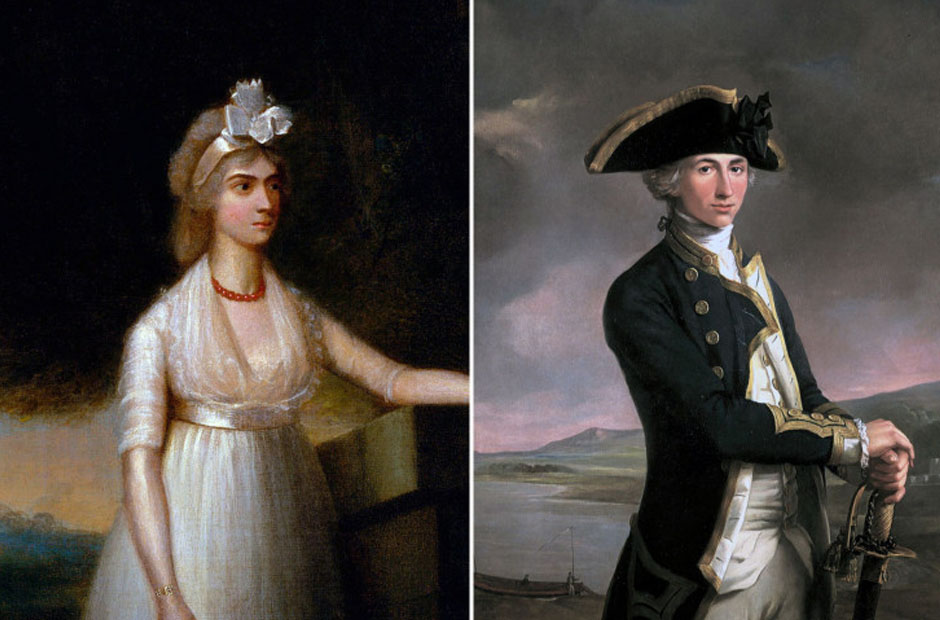
A short portrait
Frances Herbert Woolward—known in life as Frances “Fanny” Nisbet and later by marriage as Viscountess Nelson and the Sicilian Duchess of Bronté—moves through history like a steady lighthouse: immovable in the face of storms that lashed the lives around her. Born into the planter elite of Nevis late in the 1750s or in 1761 (baptised May 1761), she lived a life braided of colonial wealth, sudden widowhood, a second marriage to a rising naval star, and a long widowhood marked by dignity and distance. Her biography is a study of social texture: island lineage and English parsonage; needlework and naval strategy; public renown and private exclusion.
Basic facts
| Field | Detail |
|---|---|
| Full name | Frances Herbert Woolward |
| Also known as | Frances “Fanny” Nisbet; Viscountess Nelson; Duchess of Bronté (Sicilian title) |
| Baptism / probable birth | Baptised May 1761 (birth commonly recorded as c.1758–1761) |
| Place of birth | Nevis, British Leeward Islands |
| Parents | William Woolward (father), Mary Herbert (mother) |
| First marriage | Dr. Josiah Nisbet — married 28 June 1779 (widowed 5 Oct 1781) |
| Child | Josiah Nisbet (b. c.1780) |
| Second marriage | Captain Horatio Nelson — married 11 March 1787 |
| Widowed | 21 October 1805 (husband died at Trafalgar) |
| Death | 4 May 1831, London |
| Notable roles | Planter-family heiress; naval officer’s wife; household manager; patron of domestic arts |
Timeline: key dates and turning points
| Year / Date | Event |
|---|---|
| c.1758–1761 | Birth on Nevis; baptised May 1761 |
| 28 June 1779 | Marriage to Dr. Josiah Nisbet |
| 5 Oct 1781 | Death of Dr. Josiah Nisbet; Frances becomes a widow with an infant son |
| 11 March 1787 | Marriage to Horatio Nelson at Montpelier, Nevis |
| 1790s–1800s | Periods of separation from Nelson as his naval career and personal life evolve |
| 21 Oct 1805 | Death of Horatio Nelson at the Battle of Trafalgar |
| 4 May 1831 | Death of Frances Herbert Woolward in London |
Family table: immediate relations
| Name | Relationship | Notes |
|---|---|---|
| William Woolward | Father | Senior judge on Nevis; partner in local firm |
| Mary (née Herbert) Woolward | Mother | Member of the Herbert family of Nevis; died during Frances’s childhood |
| Dr. Josiah Nisbet (senior) | First husband | Married 1779; died 1781 |
| Josiah Nisbet (the younger) | Son | Born c.1780; later served in the Royal Navy and became an officer |
| Horatio Nelson | Second husband | Married 11 March 1787; famed British admiral |
| Reverend Edmund Nelson | Father-in-law | Frances cared for him in England; cordial household relations recorded |
The early island years and an abrupt change of fortune
Frances was born into the brittle grandeur of Caribbean plantation society: names, houses, firms and island politics forming a lattice around young lives. The Woolwards occupied a place near the top of that lattice; William Woolward served in legal office and in mercantile partnership. Childhood in that world meant both comfort and precariousness: wealth was real but often mortgaged, kinship was security and survival at once.
Orphanhood and financial strain entered Frances’s life early. Her mother died while she was still a child; her father’s death in 1779 left her and her infant son exposed to creditors and dependent on relatives. Those years reshaped expectations. They also placed Frances on a path back and forth between island and metropole that would define her adult life.
Two marriages, two worlds
Her first marriage, in 1779, was short-lived: a union with Dr. Josiah Nisbet that ended with his death in 1781. Widowhood at a young age with an infant son left Frances returning to Nevis and to the protection of an uncle and extended family. It is in this interval that the Atlantic becomes a conduit rather than a barrier.
The second marriage—11 March 1787 at Montpelier, Nevis—to Horatio Nelson connected Frances to a man who would, in a few years, grow into one of Britain’s most celebrated naval commanders. The marriage brought elevation in status and title. It also placed Frances in the difficult position of being the legal wife of a public celebrity whose life moved on the sea and, later, in the fevered public square of scandal.
Household, hearth, and the arts of a naval wife
Frances’s public “work” was domestic in the old sense: managing a household, maintaining a social front, and tending kin. She ran the parsonage when needed, cared for her father-in-law, and kept the house in moments when her husband’s duties carried him far away. Her accomplishments—watercolour, needlework, French conversation—were the gentle polish society expected and admired. They were also tools: a way to command respect, to keep faith with social codes, and to leave an imprint when political or personal turbulence made action in the public sphere impossible for a woman of her standing.
Estrangement, loyalty, and widowhood
The public arc of Horatio Nelson’s life—victories, celebrity, and the celebrated liaison with Emma Hamilton—created a private fallout. Where the public celebrated, Frances felt the loss of intimacy. The marriage, initially congenial, weakened under sustained absence and public scandal. Nelson’s later refusal of contact deepened the fracture between them. Yet Frances carried the title, the dignity, and a peculiar kind of loyalty: she remained, in name and in memory, his legal widow and custodian of a certain portion of his legacy.
Widowhood after Trafalgar left Frances titled but isolated from the circle that had formed around Nelson’s life in its later years. She lived the remainder of her life in London, a titled figure whose story is measured not by loud acts but by steady endurance. She died on 4 May 1831.
Legacy in descendants and memory
Frances’s line continued through her son Josiah and into families that maintained naval connections across succeeding generations. Names recur: sailors, officers, and those who inherited family papers and objects that passed into museum provenance or private collections. The web of descendants—some marrying into other naval families—kept fragments of the Nelson household alive: letters, miniatures, and family lore that trace social history as reliably as any ledger.
Frances Herbert Woolward’s life resists tidy moral judgments. It is instead a study in social station and adaptation: an island heiress who became the wife of a national hero, who endured financial uncertainty and personal exclusion, and who kept the household needlework and watercolour steady even as the world around her writhed. She remains, in memory and in record, a woman whose life was threaded through empire, kinship and the long, patient business of keeping a house—and a name—intact.