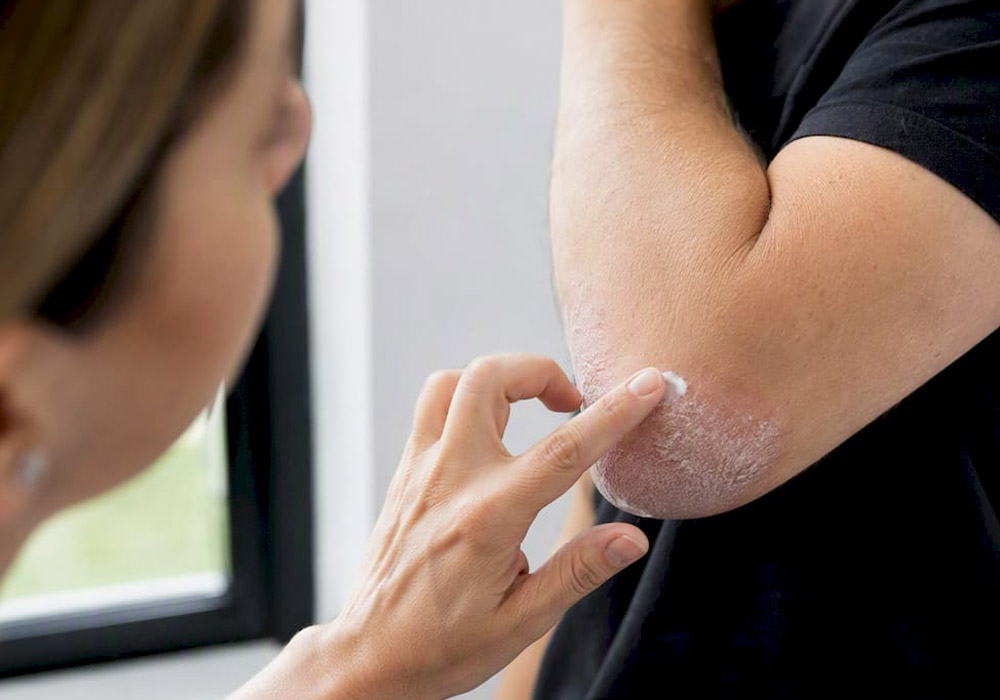
Elbows are the place psoriasis loves most. They take the pressure when you lean on a desk. Then the friction of rolled-up sleeves, and the rubbing of a winter coat.
That combination explains why the plaques there are often thick, stubborn and slow to shift. It also explains why the product that works on your forearm may do very little on your elbow.
The vehicle matters as much as the active ingredient. That is the part most people skip.
Why the Elbows Keep Getting Picked
Psoriasis is an immune-driven condition in which skin cells turn over far too quickly. Normal skin renews in about a month.
In a psoriatic plaque the cycle can run in three or four days, and the result is the silvery scale that builds up on the surface of the skin.
Elbows, knees and the lower back are classic sites for a reason. They take repeated mechanical stress, which is why trauma and friction can trigger a new plaque in skin that is already predisposed, a response clinicians call the Koebner phenomenon.
So the elbow plaque is not random. It is the area your body has decided to defend, and it thickens every time it is irritated.
That thick scale is also why a thin lotion struggles. It sits on the scale. It never reaches the skin.
What a Gel Does That a Lotion Doesn’t
A lotion is mostly water and oil, built for large areas and fast absorption. A gel is a lighter, alcohol or polymer-based base that dries within a minute or two. No film. No residue on clothing.
On an elbow, that difference is practical rather than cosmetic. You can apply a gel and put a shirt on straight away. You can lean on a desk without leaving a mark.
There is a clinical angle too. Thick plaques benefit from occlusion and from products that stay where they are put, and gels hold their shape on a dry, scaly surface where a runny lotion slides off the point of the elbow.
Where the gel still loses
On very thick, cracked plaques, an ointment usually wins. It traps moisture and softens scale. A gel cannot. That is the whole case for the ointment. If the skin is fissured and bleeding, a drying base will sting.
The sensible rule is simple. Gel for elbows, knees and scalp margins, where residue is a problem and the plaque is not broken. Ointment for the thick, dry, unbroken plaques you can wear at night.
Where Tazarotene Gel Fits
Tazarotene is a prescription retinoid. The cream versions were approved for plaque psoriasis in 2000.
A prescription strength Tazarotene Gel is the form usually reached for on elbows and scalp edges. It dries down, leaves no film, and stays put on a plaque that rubs against sleeves all day.
It works on two fronts. It slows the overproduction of skin cells that creates the scale. Over time it also reduces plaque thickness.
This is not a quick fix. Most people see a real change at eight to twelve weeks, not at two, which is why so many tubes get abandoned before they have had a chance.
Dermatologists often pair it with a topical corticosteroid. The steroid calms the inflammation and reduces the retinoid irritation, while the retinoid keeps working on the cell turnover. Used together, each can be applied less often than either would need alone.
That pairing is not a compromise. It is the standard way to make a retinoid tolerable enough to keep using.
The strength question
Tazarotene comes in 0.05% and 0.1% concentrations. The higher strength is not automatically better. Elbow skin is thicker than the face, so it can often take more. The first three weeks decide whether you stay on it.
Starting lower and moving up beats starting high and quitting.
Short Contact: Minutes Instead of Hours
Retinoid irritation is the main reason people give up on topical treatment. Redness, burning, peeling and itching are common in the first weeks. The elbow is not a forgiving site.
Short contact therapy is the workaround. Minutes, not hours. Instead of leaving the product on overnight, you apply it, leave it for a set time, and wash it off.
One multicentre study used 0.1% tazarotene gel once daily for 20 minutes, then washed it off, for 45 days. Forty-three patients took part. Irritation was milder than with the standard overnight application.
The short contact therapy study in Dermatology has the detail. Twenty minutes, three nights a week, is a workable start. Shorten it if the skin stings.
Washing it off does not cancel the effect. It reduces the dose your skin receives, which lowers irritation while keeping enough exposure to do something useful.
The Sun Problem Nobody Mentions
Tazarotene makes skin more sensitive to sunlight, and the label advice is explicit: avoid sunlamps and weather extremes, use sunscreen daily, and be careful with other medicines that increase photosensitivity.
For an elbow, that is easy to forget. The site is exposed every time you wear short sleeves. It is also the patch most likely to catch sun on a drive.
Cover it. Or use a broad-spectrum sunscreen on the treated area, and skip the sunbed while you are using it. If the plaque becomes intensely red or starts to weep, stop and speak to your prescriber.
Building a Routine That Survives Winter
Most topical routines fail in January. The air is dry. The heating is on. The plaque cracks. That is when people stop, and the plaque comes back thicker than before. Winter is the test.
An emollient is not optional in that season. Apply it through the day and use it liberally on the nights you skip the retinoid, because it reduces the dryness that makes the retinoid sting. Keep the sequence short.
- Emollient in the morning, before getting dressed.
- Retinoid at night, on dry skin, on the nights you have chosen.
- Sunscreen on exposed elbows whenever sleeves are short.
- A written note of which nights you used it, because memory is unreliable after three weeks.
Keep the number of products small. A routine with four steps that you actually follow beats a ten-step plan you abandon in a fortnight.
When Elbow Plaques Need More Than a Topical
Topicals work well for limited disease. They do not fix widespread plaques, and they do nothing for the joint pain that can come with psoriasis.
Ask for a review if the plaques cover more than a few patches. Also if they are on your palms, soles, face or genitals, or if your joints are stiff and painful in the morning.
Psoriatic arthritis is common enough to be checked rather than assumed away.
Also ask if nothing has changed after three months of consistent use. At that point the question is not which cream to try next. It is whether the treatment plan matches the severity of the disease.
Elbows are a small area of skin. They are also the area most likely to tell you whether a routine is working, because the plaque is thick, visible, and unforgiving of half-measures.