Moving from thin-gauge sheet metal to heavier material sounds like a simple scaling problem — just apply more force and the same process should work. In practice, thicker material introduces an entirely different set of engineering considerations that touch press selection, tooling design, and material behavior all at once.
What Actually Qualifies as Heavy Gauge
Gauge thickness classifications vary somewhat by industry and material type, but heavy gauge generally refers to material substantially thicker than what standard light-duty stamping processes handle — often ranging from roughly a quarter inch and thicker, depending on the specific material and application involved. At these thicknesses, material behaves quite differently under forming pressure than thinner stock does, requiring adjustments across nearly every stage of the stamping process to account for that difference.
Why Press Tonnage Requirements Scale Dramatically
Forming force requirements increase substantially as material thickness grows, since thicker material simply resists deformation more than thinner stock. This means stamping heavier material requires presses with significantly higher tonnage capacity than lighter-gauge work demands — a press adequate for standard sheet metal work often can’t generate sufficient force for heavier material without risking incomplete forms or excessive tool wear from operating beyond appropriate capacity. Facilities investing in higher-tonnage press capacity open up the ability to take on heavier gauge work that would otherwise be entirely out of reach.
How Tooling and Die Design Must Adapt
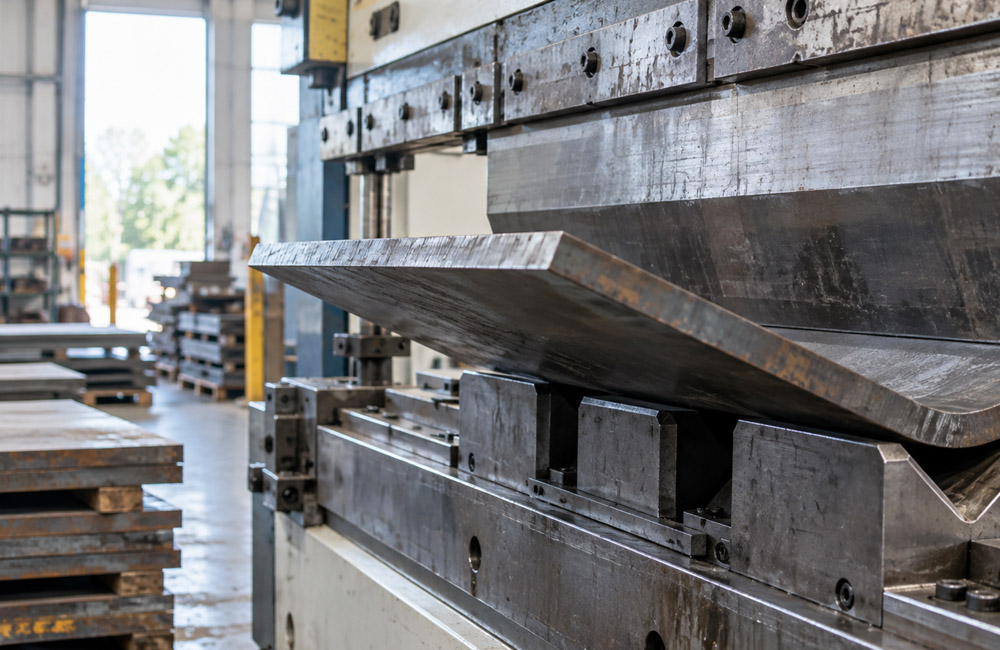
Dies designed for heavy gauge work need to withstand substantially higher forming forces without premature wear or failure, which typically means more robust construction, different steel selection for die components, and careful engineering around stress concentration points that see disproportionate load during heavier forming operations. Clearance between die components also requires more careful calculation for thicker material, since the relationship between material thickness and appropriate clearance directly affects both part quality and tool longevity over a production run.
Material Behavior Changes at Greater Thickness
Thicker material exhibits different springback characteristics than thin stock, meaning the material’s tendency to partially return toward its original shape after forming requires different compensation calculations in both die design and process planning. Heavier gauge material also generally requires more attention to grain direction and material properties, since these factors can affect forming consistency more noticeably at greater thickness than they typically do with thin, more forgiving sheet stock.
Applications That Specifically Require Heavy Gauge Capability
Structural automotive and truck components, suspension parts subject to significant load-bearing demands, and heavy equipment components all frequently require heavy gauge material to meet strength and durability specifications that thinner material simply couldn’t satisfy. These applications typically can’t be value-engineered down to lighter material without compromising the structural performance the part actually needs to deliver in real-world use, which is why this capability represents a genuine differentiator among metal forming suppliers.
Quality Control Considerations Unique to This Work
Working with thicker material demands rigorous quality control processes, since the cost of a defective heavy gauge part — both in wasted material and lost production time — runs considerably higher than an equivalent error in lighter gauge work. Dimensional verification, careful monitoring for cracking or excessive thinning at critical stress points, and consistent process parameter control across a production run all matter significantly more at this scale, where a single process deviation can affect a much more expensive piece of material.
Why Press Capacity Investment Matters for Supplier Selection
Not every metal stamping supplier maintains the press capacity and tooling expertise required for heavy gauge work, which makes verifying actual capability an important step in supplier evaluation rather than assuming any stamping shop can handle heavier material on request. Suppliers who have invested specifically in higher-tonnage press equipment and heavy gauge tooling expertise over time tend to execute this kind of work more reliably and consistently than shops attempting it occasionally, outside their typical scope of standard production work.
Working With Suppliers Who Have Real Experience at This Scale
Businesses sourcing heavy gauge stamping for structural or load-bearing components benefit significantly from working with suppliers who maintain both the appropriate press tonnage and the accumulated process expertise this kind of work genuinely requires. A supplier’s track record with similar material thicknesses and part geometries offers a far more reliable indicator of capability than press specifications listed in isolation, since executing this work well depends as much on accumulated process knowledge as on raw equipment capacity alone.
What to Ask When Evaluating Capability
A few direct questions help clarify whether a potential supplier genuinely has the experience this work requires: What’s the maximum material thickness they’ve successfully run in production, not just in isolated testing? What tonnage presses do they actually have available for this specific application? Can they provide examples of similar heavy gauge parts they’ve produced at meaningful volume? Clear, specific answers tend to separate suppliers with genuine heavy gauge experience from those simply willing to attempt it without a real production track record behind them.
Why Long-Term Equipment Investment Signals Real Commitment
Suppliers who have steadily expanded their press tonnage capacity over time — rather than operating with a single legacy press stretched beyond its practical limits — tend to demonstrate a more genuine, sustained commitment to this kind of work rather than treating it as an occasional exception to standard production. This pattern of ongoing investment often correlates with the kind of deep process knowledge that only accumulates through consistent, repeated exposure to the specific challenges heavier material introduces, rather than sporadic attempts at unfamiliar work.
Conclusion
This kind of work demands fundamentally different press capacity, tooling design, and process control than standard sheet metal work, not simply a scaled-up version of the same process. Partnering with a supplier who has genuinely invested in both the equipment and the accumulated expertise this work requires makes the difference between consistent, reliable parts and costly, avoidable production problems.