Concrete is one of the most versatile construction materials available for residential and commercial properties. From driveways and patios to retaining walls and structural foundations, professionally installed concrete provides a durable surface capable of handling heavy loads, changing weather conditions, and everyday use.
Hiring a concrete contractor in Northern Kentucky can help address several common construction needs. The region’s rolling terrain, seasonal temperature changes, and drainage challenges make proper concrete installation especially important.
A qualified concrete contractor can evaluate the property, prepare the ground, select appropriate materials, and install concrete structures designed for their intended use.
Understanding the different types of concrete projects can help homeowners and business owners determine which improvements make sense for their properties.
1. Concrete Driveway Installation and Replacement
Driveways | Repair or Replace | Concrete Contractors and Excavating in Kansas City — Blankenship Excavating
Miller Concrete | Professional Concrete Contractor in Middleburg, PA
Home | AGR Concrete Inc
8
Concrete driveway installation is one of the most common projects handled by residential concrete contractors.
A properly constructed concrete driveway provides a stable surface for vehicles while improving access to the property. Compared with gravel driveways, concrete requires less routine grading and eliminates problems associated with loose stones and ruts.
Common driveway projects include:
- Installing concrete driveways for newly constructed homes
- Removing and replacing cracked or deteriorating driveways
- Widening existing driveways to accommodate additional vehicles
- Constructing parking pads for recreational vehicles or trailers
- Installing driveway extensions and turnaround areas
- Replacing gravel driveways with concrete
What Makes a Concrete Driveway Last?
Driveway performance depends heavily on the work completed before the concrete is poured.
Contractors must evaluate soil stability, remove unsuitable material, establish the proper subgrade, and compact the aggregate base. The driveway must also have adequate thickness, reinforcement where appropriate, and correctly spaced control joints.
Drainage is another important consideration. A driveway should direct water away from the home’s foundation and prevent water from collecting beneath the concrete.
In Northern Kentucky, these construction details are particularly important because repeated freezing and thawing can contribute to cracking, surface deterioration, and movement when water becomes trapped beneath the slab.
2. Concrete Patios and Outdoor Living Spaces
Broom Finish Patio and Outdoor Kitchen – Contemporary – Patio – Kansas City – by Artistic Concrete Surfaces | Houzz
21+ Stylish Stamped Concrete Patio Ideas
Patio Construction Kansas City | Concrete, Pavers, Flagstone & Stamped Concrete
9
Concrete patios provide a durable foundation for outdoor entertainment, dining, and relaxation areas.
A concrete contractor can construct a simple backyard patio or develop a larger outdoor living space that incorporates multiple functional areas.
Popular concrete patio projects include:
- Traditional broom-finished concrete patios
- Stamped concrete patios
- Covered patio foundations
- Outdoor dining areas
- Concrete surfaces surrounding fire pits
- Walkways connecting patios to other outdoor features
- Concrete foundations for outdoor kitchens
One advantage of concrete is its flexibility. Contractors can design patios in different shapes and dimensions to accommodate the home’s layout and the available yard space.
Why Site Preparation Matters for Concrete Patios
A patio must be installed over stable ground with proper drainage.
If the ground beneath the patio settles unevenly, the concrete may crack or shift. Improper slope can also cause rainwater to collect near the house.
A contractor should evaluate how water moves across the property and establish a finished surface that directs runoff toward an appropriate drainage area.
For Northern Kentucky properties with sloping backyards, patio construction may also require excavation, grading, or retaining structures to create a usable outdoor space.
3. Stamped and Decorative Concrete Projects
Stamped concrete allows property owners to achieve decorative patterns while maintaining the functional benefits of a poured concrete surface.
During installation, contractors apply texture and patterns to the concrete before it fully hardens. Depending on the selected design, the finished surface can resemble stone, brick, slate, or other materials.
Common decorative concrete applications include:
- Backyard patios
- Pool decks
- Front entryways
- Courtyards
- Decorative walkways
- Outdoor entertainment areas
Color can be incorporated into the concrete or applied through compatible coloring systems to create different finishes.
Is Stamped Concrete as Durable as Regular Concrete?
Stamped concrete can provide comparable structural performance to conventional concrete when both are designed and installed correctly. However, decorative surfaces have additional maintenance considerations.
Stamped concrete often requires periodic cleaning and resealing to protect its appearance. Sealers can also affect surface traction, especially around swimming pools and other wet areas.
Contractors should consider texture, drainage, slip resistance, and maintenance requirements when recommending decorative finishes.
4. Concrete Sidewalks and Walkways
Expert Concrete sidewalk building Decatur IL | Decatur Concrete
Concrete Sidewalk Contractor Near Me | WhitePlains Concrete
Project Gallery | Concrete Work by Rhode Concrete Corporation | Rhode Concrete
9
Concrete sidewalks and walkways improve how people move around residential and commercial properties.
They provide defined routes between driveways, entrances, patios, garages, and other outdoor features.
Typical projects include front entrance walkways, backyard paths, sidewalks connecting detached garages, and pedestrian access routes around commercial buildings.
A concrete contractor can also replace uneven sidewalks that have become difficult to navigate because of settlement, tree roots, or deterioration.
Important Considerations for Walkway Installation
Walkways must be designed for their intended use.
Residential paths should provide comfortable walking space and adequate traction. Commercial walkways may need to meet applicable accessibility requirements, including specific limitations on slopes and changes in elevation.
Contractors should also evaluate drainage and nearby landscaping. Tree roots, poorly compacted soil, and concentrated water runoff can contribute to movement over time.
For properties with significant elevation changes, walkways may need to incorporate steps, landings, or carefully designed transitions.
5. Concrete Steps, Stairs, and Entryways
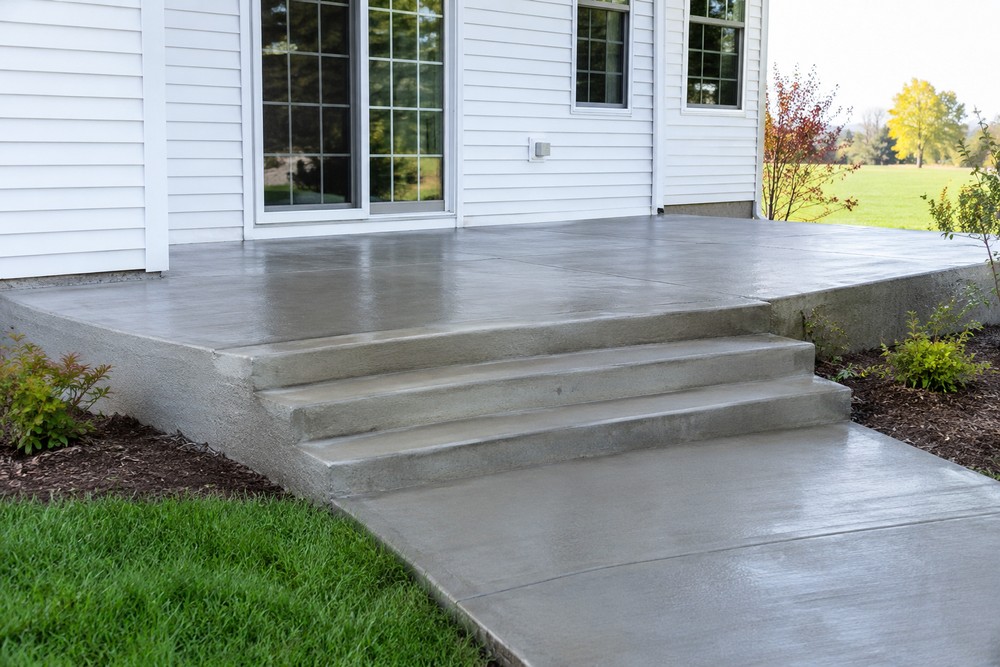
Concrete contractors can construct exterior steps and stairways that provide access to homes, garages, patios, and commercial buildings.
These projects are particularly useful on properties where the entrance sits above the surrounding grade.
Common applications include front porch steps, basement entrance stairs, backyard transitions, and steps connecting different patio elevations.
Exterior concrete stairs require careful planning because inconsistent step dimensions can create tripping hazards.
Contractors must account for applicable building codes, uniform riser heights, tread dimensions, landings, and handrail requirements.
Proper drainage is equally important. Water should not be allowed to collect on stair treads or freeze near frequently used entrances.
6. Concrete Garage Floors and Workshop Slabs
Concrete slabs provide the structural surface for garages, workshops, storage buildings, and other accessory structures.
These projects require different construction considerations than a standard patio or sidewalk because the finished surface may support vehicles, equipment, storage systems, or machinery.
A concrete contractor may install:
- Attached and detached garage floors
- Workshop slabs
- Storage building foundations
- Equipment pads
- Utility building floors
- Slabs for certain agricultural buildings
How Are Concrete Slabs Designed for Heavy Loads?
The slab’s thickness, reinforcement, base preparation, and concrete strength should reflect its intended use.
A garage used for passenger vehicles may have different requirements than a workshop supporting heavy machinery or vehicle lifts.
Concentrated loads, such as lift posts, may require specially designed footings or reinforced slab sections.
Contractors should establish these requirements before construction rather than assuming every concrete slab can support the same weight.
7. Concrete Foundations and Footings
Concrete foundations transfer the weight of a structure into the supporting soil.
Depending on the contractor’s capabilities and the project’s engineering requirements, concrete work may include footings, foundation walls, slab-on-grade foundations, and foundations for accessory buildings.
Typical projects include foundations for detached garages, home additions, sheds, workshops, and certain outdoor structures.
Why Foundation Construction Requires Careful Planning
Foundation construction begins with evaluating soil conditions, anticipated structural loads, and site drainage.
Footings must be properly sized and placed at depths appropriate for the structure and local requirements.
In Northern Kentucky, contractors must also consider frost protection and how water moves through the surrounding soil.
Improper foundation preparation can contribute to settlement, cracking, and structural movement.
Projects involving load-bearing foundations may require engineered plans, permits, inspections, and specialized foundation contractors.
8. Concrete Retaining Walls and Landscape Structures
13+ Stylish Poured Concrete Retaining Wall Ideas
EF Gomez Cement Contractor | Bay Area Concrete Since 1993
Retaining Walls in Washington, DC
11
Retaining walls hold back soil and help manage changes in ground elevation.
Northern Kentucky’s hilly terrain makes retaining structures especially relevant for properties with steep yards, sloping driveways, and uneven outdoor living areas.
Concrete-related retaining wall projects may include poured concrete walls, reinforced concrete walls, and concrete masonry retaining systems.
These structures can help create usable yard space, support landscape transitions, and manage soil around driveways or patios.
Why Drainage Is Critical Behind Retaining Walls
A retaining wall must resist pressure from the soil behind it. Water buildup can significantly increase that pressure.
Proper retaining wall construction may require drainage stone, perforated drainpipes, appropriate backfill, and outlets that allow collected water to escape.
Wall height, soil conditions, slope, and nearby structures determine whether engineering and permits are necessary.
Not every general concrete contractor specializes in retaining walls. Property owners should confirm that the contractor has experience with the specific wall system and structural requirements.
9. Concrete Pool Decks and Surrounding Surfaces
Concrete is frequently used around swimming pools because it can create a continuous, customizable surface.
Pool deck projects may include traditional concrete, textured finishes, decorative concrete, and stamped designs.
A contractor can construct surrounding walking areas, outdoor seating spaces, and transitions between the pool and patio.
What Makes Pool Deck Concrete Different?
Pool decks require special attention to drainage, traction, and movement.
The finished surface should direct water away from the pool where appropriate and reduce standing water around frequently used areas.
Contractors must also consider the pool structure, coping, expansion or isolation joints, and the possibility of differential movement between the deck and surrounding structures.
Surface texture is particularly important because smooth or heavily sealed concrete can become slippery when wet.
For fiberglass pool installations, coordinating deck construction with the pool installer helps ensure proper elevations, drainage, and transitions.
10. Concrete Parking Areas and Commercial Flatwork
Concrete contractors also complete projects for businesses, property managers, and commercial property owners.
Commercial concrete flatwork includes horizontal surfaces such as sidewalks, parking areas, loading zones, and equipment pads.
Potential projects include:
- Small commercial parking lots
- Concrete parking pads
- Loading and unloading areas
- Commercial sidewalks
- Dumpster pads
- Equipment foundations
- Concrete access paths
- Replacement of damaged exterior slabs
Commercial concrete projects often involve higher traffic volumes and heavier loads than residential installations.
A contractor must consider vehicle types, expected loading, drainage, reinforcement, accessibility, and applicable construction specifications.
For heavily loaded commercial applications, engineered pavement designs may be necessary.
11. Concrete Demolition, Removal, and Replacement
Not every concrete project begins with an empty construction site.
Many homeowners need existing concrete removed before a replacement surface can be installed.
Common replacement projects include deteriorating driveways, cracked patios, uneven sidewalks, damaged garage floors, and aging concrete steps.
Should Damaged Concrete Be Repaired or Replaced?
The answer depends on the extent of the damage and its underlying cause.
Minor surface defects may be suitable for certain repair methods. However, extensive cracking, significant settlement, and unstable subgrade conditions can make replacement more practical.
Before recommending replacement, a contractor should determine whether the damage resulted from poor drainage, inadequate base preparation, soil movement, or another condition.
Simply pouring new concrete over an unresolved problem can allow similar damage to develop again.
12. Concrete Pads for Outdoor Equipment and Structures
Concrete pads provide level, stable surfaces for equipment and outdoor structures.
These smaller projects can be valuable because they help keep equipment off unstable soil and create defined installation areas.
Examples include concrete pads for HVAC equipment, generators, trash storage areas, hot tubs, outdoor storage structures, and utility equipment.
Each application has different requirements.
For example, a hot tub pad must support the combined weight of the filled tub and its occupants. Generator pads may need to meet manufacturer requirements for dimensions, clearances, and anchoring.
A contractor should review the intended equipment specifications before determining the appropriate slab design.
Why Northern Kentucky Properties Require Careful Concrete Planning
Concrete construction in Northern Kentucky presents several challenges that contractors must account for during project planning.
Freeze-Thaw Cycles
Winter temperatures can repeatedly move above and below freezing.
When water enters vulnerable concrete or saturated material beneath a slab and freezes, it can contribute to surface deterioration or movement.
Proper concrete mix selection, air entrainment for exposed concrete where appropriate, drainage, and curing practices help reduce these risks.
Sloping Terrain
Many Northern Kentucky properties have substantial changes in elevation.
Installing a patio, driveway, or walkway on a slope may require additional excavation, grading, drainage improvements, or retaining structures.
A contractor should evaluate the entire installation area rather than focusing only on the dimensions of the concrete surface.
Soil Stability and Compaction
Concrete relies on the supporting material beneath it.
Loose fill, soft soil, or poorly compacted aggregate can settle after installation. This movement may lead to cracking and uneven slabs.
Contractors should identify unsuitable material, establish a stable base, and use appropriate compaction methods before pouring.
Water Management
Drainage is one of the most important considerations in outdoor concrete construction.
Water collecting near foundations, beneath driveways, or behind retaining walls can create long-term problems.
A well-planned project establishes how runoff will move across the finished surface and where that water will discharge.
How to Choose the Right Concrete Contractor in Northern Kentucky
Choosing a concrete contractor involves more than comparing estimates.
Homeowners should look for contractors who can explain how the project will be constructed and why specific installation methods are appropriate.
Important questions include:
- What site preparation is included? Ask about excavation, base material, compaction, and removal of unsuitable soil.
- How will drainage be managed? The contractor should explain the proposed slope and where runoff will go.
- What concrete specifications will be used? Discuss concrete strength, slab thickness, reinforcement, and finishes appropriate to the project.
- How will cracking be managed? Ask about control joint placement, curing, and isolation joints where needed.
- Who will oversee the work? Clarify who is responsible for scheduling, installation, inspections, and communication.
- What is included in the estimate? Confirm demolition, disposal, grading, materials, finishing, cleanup, and any exclusions.
A detailed estimate should clearly describe the proposed work so property owners can compare contractors on more than price alone.
Frequently Asked Questions About Concrete Projects
What is the most common project for a residential concrete contractor?
Driveways, patios, sidewalks, and walkways are among the most common residential concrete projects. Contractors also install garage slabs, steps, equipment pads, and other exterior surfaces.
Can a concrete contractor install a patio on a sloped backyard?
Yes. A concrete contractor can often install a patio on sloped ground by incorporating grading, excavation, and suitable support. Steeper properties may require retaining walls or engineered solutions.
How long does a new concrete driveway take to install?
Installation time depends on the driveway’s size, site preparation, weather, and project complexity. Concrete also needs adequate curing time before vehicle traffic. The contractor should provide a schedule based on the concrete mix and expected conditions.
Can concrete be poured during cold weather in Northern Kentucky?
Yes, concrete can be placed in cold weather when appropriate procedures are followed. Contractors may need to adjust the mix, protect the concrete from freezing, and maintain suitable curing temperatures.
Does every concrete project require reinforcement?
No. Reinforcement requirements depend on the slab’s purpose, dimensions, loading conditions, and design. Reinforcement can help control crack widths and maintain slab integrity, but it does not replace proper base preparation or eliminate cracking.
Can one contractor handle concrete, retaining walls, and outdoor living construction?
Some outdoor construction contractors offer all three services. Working with one company can simplify coordination when a project involves grading, retaining walls, patios, and related site improvements. Property owners should verify the contractor’s capabilities for each portion of the work.
Planning a Concrete Project in Northern Kentucky
Concrete contractors can complete a wide range of improvements, from straightforward sidewalk replacements to complex outdoor living projects involving grading, retaining walls, and drainage systems.
The right approach depends on the property’s existing conditions, the intended use of the finished surface, and the construction requirements involved.
For homeowners planning a driveway, patio, walkway, or larger outdoor improvement, Elevation Outdoor Services is a Northern Kentucky contractor to consider. The company focuses on concrete construction, hardscapes, retaining walls, and related outdoor improvements.
Discussing the project with a contractor who understands site preparation, drainage, and the challenges of local terrain can help establish a practical construction plan before work begins.