Why spring puts foundations under pressure
Spring reveals everything your house wanted to hide. A little fracture that behaved all winter becomes a secret water entry, notes Alta Property Management solutions. By April, a February garden plot becomes a marshy welcome mat. Basement smells like an old gym bag that lost to a soggy cardboard box.
Several troublemakers at once make this season hard on foundations. Rainfall rises. Water from snowmelt accumulates. Soil temps vary. Like attempting to fit into an uncomfortable chair, the earth softens, swells, settles, and changes. Your foundation struggles to stay dry and sturdy in this mess as the earth around it acts like pudding.
One major storm seldom destroys a foundation. Frequent moisture exposure wears it down. Near the walls, water remains. Soil presses unevenly. Tiny openings let wetness in. Then indications appear. Sticky basement. Hairline splits. Off-feeling floors. Doors that act like moody teens and won’t close.
That is why spring deserves special attention. It is not just a rainy season. It is a stress test for your entire drainage setup.
The yard may be secretly sending water toward the house
Many moisture problems begin before the water ever touches the foundation wall. The yard itself may be guiding runoff straight toward the home like an overenthusiastic tour guide.
Every raindrop brings difficulties if the earth slides inward. Lawn, flower bed, driveway, and adjoining property water might drift to the foundation. It pools around the base, descends into the earth, and presses against basement walls or slab edges.
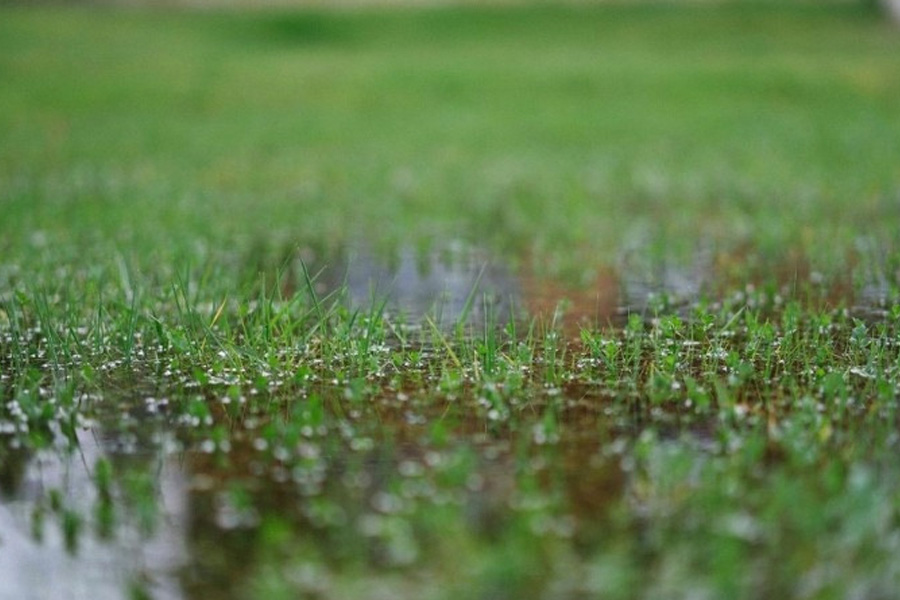
Even a little drop near the home might cause issues. These shallow low places seem unassuming yet behave like bowls. The soil stays moist when the rain ceases once filled. Soil is heavier when wet. It grows, changes readily, and weakens. None of that helps concrete.
Sometimes homeowners focus only on the house and forget that the landscape is part of the drainage system too. Mulch beds piled too high, edging that traps runoff, and decorative borders that interfere with drainage can all contribute to water collecting where it absolutely should not.
Gutters are boring until they become villains
Gutters are not glamorous. No one throws a party to celebrate clean downspouts. Yet these plain metal troughs do some of the most important work on the property.
Proper gutters gather roof runoff and direct it away from the home. When they clog, slump, overflow, or deposit water at the home’s base, they become unintended saboteurs. Roofs lose a surprising amount of water during storms. Water pouring directly beside the foundation quickly saturates the soil.
That repeated dumping creates a wet ring around the home. Then the chain reaction begins. Soil swells. Water seeps into cracks. Basement walls absorb moisture. Erosion nibbles away at the surrounding ground like a determined squirrel with a grudge.
Short downspouts make this worse. Even if the gutter itself is clean, water discharged only a foot or two from the house often circles right back toward the foundation. The result is a soggy perimeter and a basement that starts feeling suspiciously tropical.
Hydrostatic pressure is the muscle behind many leaks
Water does not need a giant hole to get inside. It just needs time, pressure, and a little patience. Unfortunately, it has all three.
When foundation soil gets wet, water pushes against subsurface walls. The force is hydrostatic pressure. Although fancy, the impression is unpleasant and relentless. It penetrates fractures, porous concrete, joints, and weak regions with moisture. Even a solid wall can let water vapor or seepage through.
Basement leaks are mysterious because of this. Homeowners typically claim no floods, busted pipes, or damage. The floor is moist, the corners smell musty, and the walls are chalky. Water leaving mineral deposits in brickwork creates the residue.
Hydrostatic pressure can also do more than cause dampness. In more serious cases, it contributes to bowing walls, floor cracks, and structural strain. Water is not just wet. It is pushy.
Expanding and shrinking soil creates a foundation roller coaster
Soil does not remain the same size all year. Certain types, especially clay-heavy soil, swell when they absorb water and shrink when they dry out. Spring often kicks off this cycle in dramatic fashion.
Imagine your foundation on a mattress with one side standing out and the other sinking. That setup is unstable. Parts of the foundation may rise, settle, or move at various speeds when moisture levels vary. The movement strains walls, floors, and structure.
The outcome may be brick stair-step fissures, window frame gaps, or sloping interior flooring. Signs may appear unconnected at first. A stuck door. A crack above a window. Tile floor with a defiant corner. Together, they may indicate changing support below.
This movement can be slow and subtle, which makes it easy to ignore. Houses are patient. They whisper before they scream.
Basements collect more than storage boxes and holiday decorations
Basements are often the first indoor spaces to reveal a spring moisture problem. They sit below grade, surrounded by soil, and naturally attract dampness when exterior water control is poor.
Some signs are obvious. Puddles on the floor. Wet wall corners. Damp cardboard boxes that feel like they spent the night in a fog machine. Other signs are sneakier. Increased indoor humidity. Condensation on cool surfaces. A persistent earthy smell that no air freshener can defeat.
Basement moisture may destroy more than concrete. Wood frame absorbs moisture. Insulation may be ineffective. Stored items can distort, mildew, or decay. Some metals rust. Paint bubbles. Failure can occur with flooring adhesives. Every item has a dramatic plotline in our basement soap opera.
Even if the basement is unfinished, excess moisture should not be shrugged off. Damp conditions encourage mold growth and can affect the overall air quality inside the home. Since air circulates upward, that musty basement smell rarely agrees to stay in the basement.
Hard surfaces can make water move faster than expected
Driveways, patios, walkways, and other paved surfaces often play a surprising role in foundation moisture problems. These surfaces do not absorb much water. Instead, they send it somewhere else, usually downhill and in a hurry.
Rainwater can flow directly to the foundation if hardscape materials slope toward the home. A walkway that collapses may become a slippery water slide. Poor patio runoff control may soak soil for days. Even attractive retaining borders might disrupt movement.
This can be especially troublesome during heavy spring storms, when water arrives quickly and in large amounts. The faster it concentrates in one area, the less time the soil has to absorb it evenly. That increases pooling, erosion, and pressure against the structure.
Small warning signs often show up before major damage
Foundation moisture problems rarely appear out of nowhere wearing a villain cape. They usually drop hints first.
Peeling paint near the basement floor may be a sign. Another possibility is masonry’s white powdery film. Cracks that expand gradually between seasons matter too. Outside, look for soil moving away from the home, mulch washing into weird areas, or ditches where runoff repeats every rain.
Interior clues can include warped baseboards, swollen trim, or a room that always feels more humid than the rest of the house. In upper areas of the home, repeated moisture below can eventually contribute to subtle settling signs such as nail pops or minor drywall cracks.
The trick is not to wait for a dramatic event. A basement does not need ankle-deep water to signal a problem. Sometimes it starts with a smell, a stain, and a suspiciously gloomy corner.
FAQ
Why do foundation moisture issues seem worse in spring than in summer?
Spring usually brings a combination of rain, snowmelt, rising groundwater, and saturated soil. In summer, the ground often has more time to dry out between storms. Spring keeps everything wetter for longer, which increases pressure around the foundation.
Can a house have moisture problems even if there is no visible basement flooding?
Yes. Moisture can enter as vapor, minor seepage, or condensation caused by damp walls and floors. You may notice musty odors, elevated humidity, or staining before you ever see standing water.
Does soil type really make a big difference?
Absolutely. Clay-rich soil is especially troublesome because it absorbs a lot of water and expands dramatically. When it dries, it shrinks. That repeated movement places stress on the foundation and can worsen cracking or settlement.
Are clogged gutters really enough to affect a foundation?
They can be. Roof runoff adds up fast during a storm. If gutters overflow or downspouts discharge too close to the house, that water saturates the soil around the foundation and increases the risk of seepage, erosion, and structural movement.
What are early signs that moisture is affecting the foundation?
Common early signs include damp basement walls, musty smells, white mineral deposits on concrete, small cracks, pooling water near the house, and areas of erosion in the yard. Doors and windows that begin sticking can also point to movement related to shifting soil.
Can landscaping make foundation moisture problems worse?
Yes. Poor grading, raised flower beds, edging that traps water, and hard surfaces sloping toward the house can all direct runoff where it should not go. Landscaping can either help drainage or quietly sabotage it.
Is a musty basement smell always a foundation problem?
Not always, but it is often linked to excess moisture entering from outside or rising through the foundation area. If the smell keeps returning, it is worth looking at drainage, grading, and moisture control around the structure.