An old fence line is never just brush
After harvest, many Canadian farms and acreages finally get to the overgrown fence line that has been waiting all summer. Saplings, roots and tangled grass come out easily enough, but so does a surprising amount of topsoil. A root rakeon a loader does this work well or badly depending less on its teeth than on the angle the operator holds it at.
Curl angle is the real control
Tipped forward, with the teeth pointing down, the rake digs. It hooks roots below the surface and drags them up. Rolled back so the comb sits nearly flat, it rides over the ground and gathers whatever is already loose.
Between those positions lies most of the skill, and the right angle changes with soil moisture and root depth. Working with a skid steer root rake means making small curl adjustments constantly rather than setting one angle and driving.
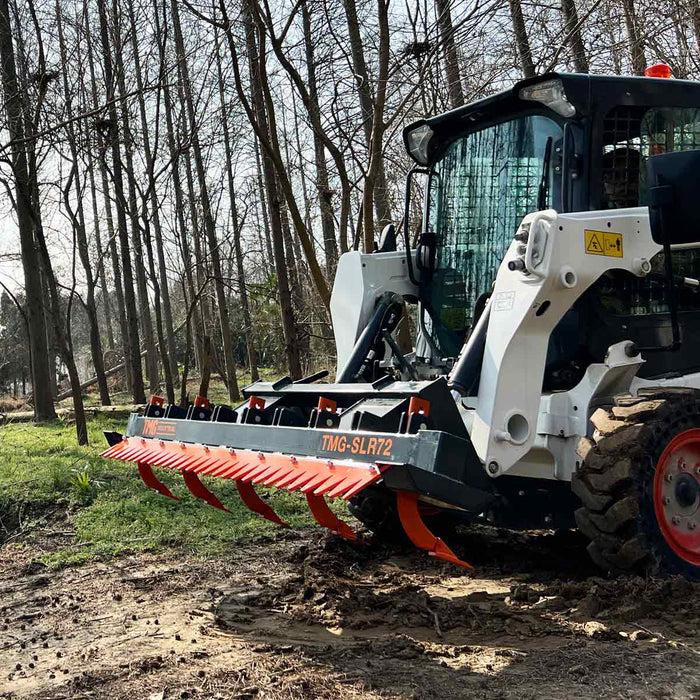
A root rake with ripper shanks works in both directions
Driving in reverse with the teeth lowered, often called back-dragging, pulls the comb backward through loosened ground. Roots and stones catch on the teeth while soil falls through, and the surface is roughly leveled at the same time.
Ripper shanks on the same frame can open compacted ground on one pass and let the comb sort it on the next, without changing attachments. The forward pass does the breaking, the backward pass does the gathering, and switching between them is only a matter of direction and curl.
Shake before you carry
A load of roots picked up from the ground holds a lot of soil in its tangle. Lifting it a little and rolling the rake back and forth a few times shakes much of that soil out before the load goes to the pile, keeping topsoil where crops or grass will need it.
Piles built from shaken roots also burn or break down far better. A pile full of soil smothers a fire, holds moisture and leaves a mound of dirt behind, while a pile of mostly clean wood burns down or can be chipped without dulling knives on grit.
What hides in an old fence line
Hedgerows collect decades of forgotten material, and very little of it shows above the grass. Before digging in, it helps to walk the whole line slowly on foot, probing suspicious spots with a bar, and look for:
- Old barbed wire: wraps teeth, hard to see
- Buried stone piles: bend shanks below the surface
- Utility lines: ripper shanks can reach them
- Large stumps: cut low first, then rake
Different attachments suit different leftovers. A rock rake has heavier, closer teeth for sorting stone out of soil. A brush rake is built for pushing and piling cut branches rather than digging roots, and a root rake sits between them, strong enough to pull roots yet open enough to let soil fall.
Timing the job before freeze-up
Moist, workable soil releases roots readily, while frozen ground lifts in slabs. Brush piles meant for burning usually require a permit, and rules vary by province and season, so checking with local authorities avoids a fine.
Piles should sit well away from standing trees, fences and buildings, on ground where a fire can be watched and put out. Leaving them to dry for a few weeks before burning makes a hotter, cleaner fire with less smoke drifting toward neighbors. TMG Industrial’s 72 inch model combines ripper shanks with a rake comb, which suits clearing work where the soil is worth keeping in the field.