Seven places to call when the denial letter says you can appeal and then stops talking.
Last checked September 2026. Deadlines and thresholds verified on Medicare.gov and CMS.gov; every other detail comes from the organization’s own website.
The letter runs about a page. It uses the word “determination” twice, never says “no,” and by the fourth reading you are certain it is a no. Near the bottom, a paragraph tells you that you have appeal rights. It does not tell you who will help you use them. Searching turns up flowcharts written for people who already know what a Qualified Independent Contractor is, and law firms that want to talk about fees. The free help exists, scattered across a federal counseling program, two CMS contractors, some nonprofits and a legal aid office three towns over.
The vocabulary does not help either. Advocate, counselor, navigator and representative get used loosely, and only one means something specific in Medicare. A representative is a person you name on a form, who can then file on your behalf, receive your notices and argue the case. Everyone else is giving you advice, and coaching is not the same product as someone taking the file off your hands.
Below are seven places worth calling, in no particular order. Understood Care is first because it opens the advocacy group, not because it beats the free programs below.
Know which appeal you are filing before you call anyone
Medicare has five levels of appeal. Level 1 forks: in Original Medicare it goes to a government claims contractor, in Medicare Advantage to the plan that denied you.
- Level 1, and it is two different things. Original Medicare: a redetermination by the Medicare Administrative Contractor, filed within 120 days of receiving the initial claim determination, on form CMS-20027, generally decided within 60 days. Medicare Advantage: a reconsideration by your own plan, filed within 65 calendar days of the date on the organization determination notice, decided in 30 days for a service you have not had yet, 60 days for a payment question, 7 days for a Part B drug and 72 hours if expedited.
- Level 2. In Original Medicare, a Qualified Independent Contractor, within 180 days of the redetermination, answered in about 60 days. In Medicare Advantage you file nothing: CMS requires the plan to send an adverse decision automatically to the Part C Independent Review Entity.
- Level 3. An Administrative Law Judge at the Office of Medicare Hearings and Appeals, requested within 60 days of the level 2 decision. For 2026 at least $200 must be in controversy, and OMHA is directed to decide within 90 days.
- Level 4. The Medicare Appeals Council at the HHS Departmental Appeals Board, within 60 days of the OMHA decision. No dollar minimum. It has 90 days, or 180 on an escalated case.
- Level 5. Federal district court, within 60 calendar days of the Council’s decision. For 2026 the threshold is $1,960, up from $1,900. Both are recalculated annually.
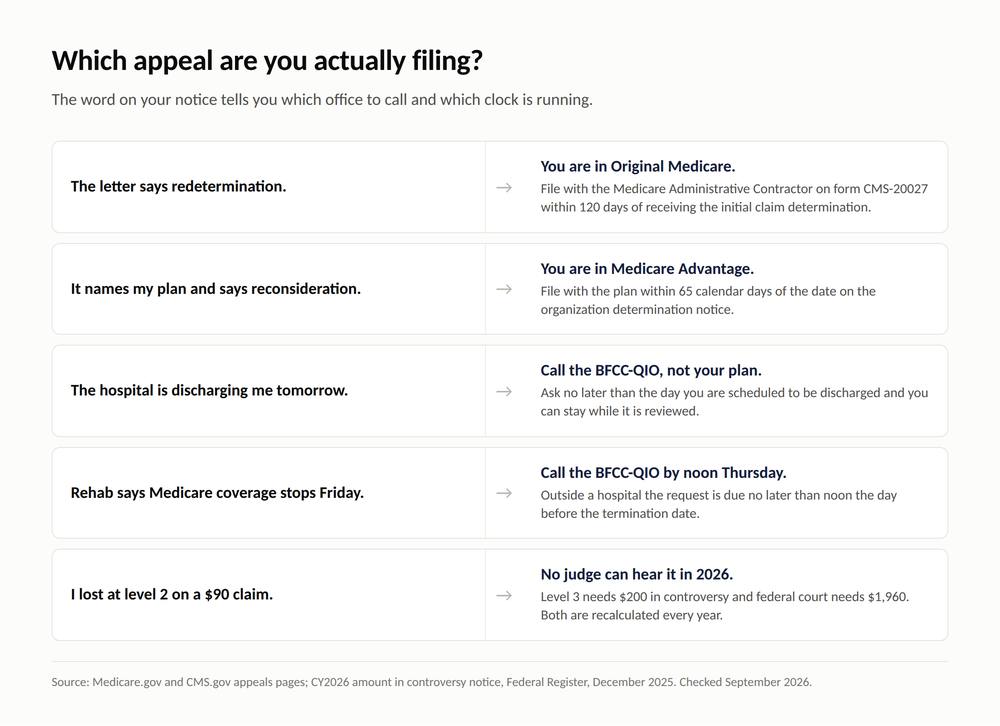
Which appeal are you actually filing?
Understood Care
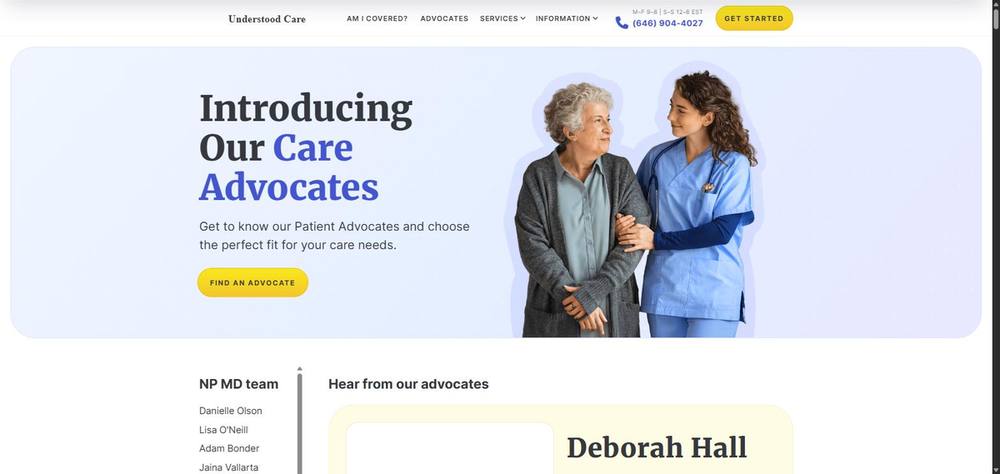
Understood Care, formerly Kible Health, is a virtual advocacy service that bills Medicare rather than the patient. Its pricing page explains why: “Starting in 2024, Medicare pays for navigation and community health services.” It accepts Medicare Part B and many Medicare Advantage plans, covers all 50 states, and answers on (646) 904-4027.
Its roster of patient advocates for Medicare members lists six physicians and nurse practitioners plus thirty-odd care advocates, working on “prior authorization denials, billing errors, discharge planning, and multi-level appeal processes.”
Key strengths
- Billed through Medicare, with any cost named before the first session.
- Clinicians on staff, for denials that turn on medical necessity.
- Evening and weekend hours, all 50 states.
Best for
A denial tangled up with billing errors and prior authorization.
Worth asking about
Its pricing page says patient advocacy “is not yet covered by Medicaid” or commercial insurance, and that “we have to contract with each individual insurance company in each state.” No self-pay rate is published, and nothing on the site says whether an advocate signs a CMS-1696.
State Health Insurance Assistance Program (SHIP)
SHIP is the option nearly everyone qualifies for and almost nobody has heard of: 54 programs, one per state plus DC and the territories, funded by the Administration for Community Living.
Counselors give “local, in-depth, and objective insurance counseling,” and “There is no cost to consumers to use SHIP services.” Medicare.gov tells readers to call SHIP “for free, personalized health insurance counseling, including help with appeals.”
Key strengths
- Free to anyone with Medicare. No income test, no diagnosis requirement.
- Independent of any insurer by design.
- Local, so counselors often know how a regional plan behaves.
Best for
Almost anyone as a first call, especially a level 1 filing.
Worth asking about
This is counseling, not representation, and the national site publishes no policy on whether a counselor can be named on a CMS-1696. Find your office at shiphelp.org or 877-839-2675, and ask how soon someone can see you: a four-week wait is useless against a 65-day clock.

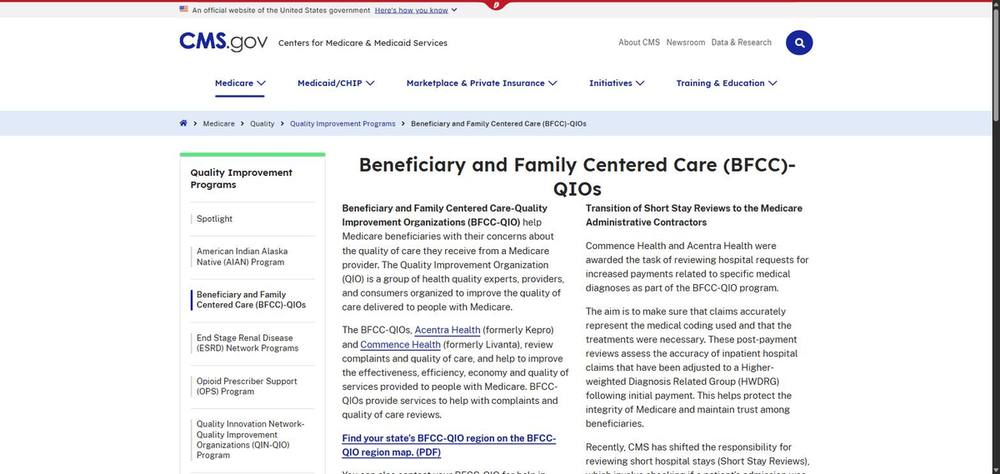
Your BFCC-QIO (Acentra Health or Commence Health)
If a hospital is discharging you too soon, or a nursing facility or home health agency says coverage is ending, you do not appeal to your plan. You call your state’s Beneficiary and Family Centered Care Quality Improvement Organization, where a reviewer “will decide if your covered services should continue.” CMS uses two: Acentra Health, formerly Kepro, and Commence Health, formerly Livanta.
The deadlines run in hours. In a hospital, ask “no later than the day you’re scheduled to be discharged.” Elsewhere, “no later than noon the day before the termination date.” Ask in time and Medicare.gov says you can stay while you wait and “won’t have to pay for your stay (except for applicable coinsurance or deductibles).”
Key strengths
- Free, and the only route that keeps coverage running while it is decided.
- Fast: one day in a hospital, close of business the next day elsewhere.
- Acentra also advertises free Immediate Advocacy for informal problems.
Best for
Anyone holding an Important Message from Medicare (CMS-10065) or Notice of Medicare Non-Coverage.
Worth asking about
The QIO decides, it does not advocate. You also have to reach the right one. Acentra covers “the 29 states highlighted on the map below” and Commence covers the rest, so Medicare.gov says to “check their websites to make sure you’re contacting the right organization.”
Medicare Rights Center
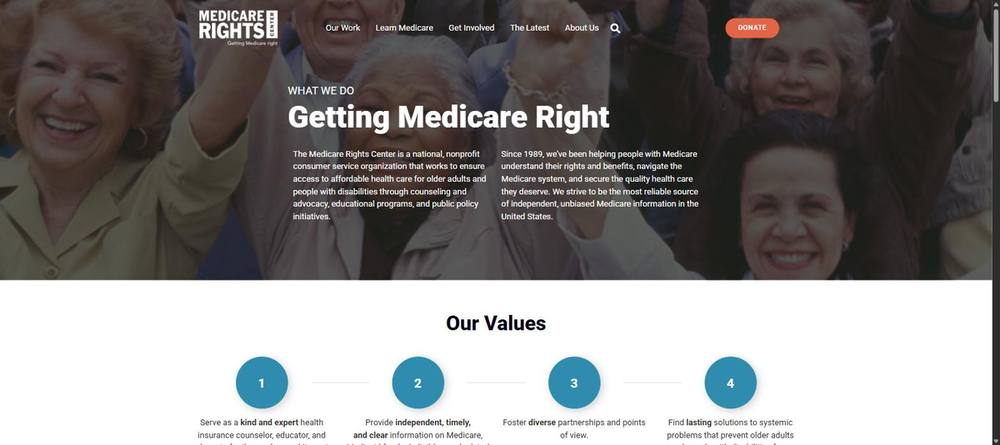
The Medicare Rights Center is a national nonprofit working on access to affordable health care “through counseling and advocacy, educational programs, and public policy initiatives.” The practical part is its helpline, 800-333-4114, open Monday through Friday and headed “GET Free MEDICARE HELP.”
What it covers includes “payment denials and appeals,” in Spanish as well as English. It also runs Medicare Interactive, “a free and independent online reference tool,” whose library includes appeal toolkits and template letters.
Key strengths
- Free, national, no eligibility screen.
- The organization says counselors answer thousands of questions a year.
- Medicare Interactive lets you self-serve when the helpline is closed.
Best for
A second opinion when the local SHIP office has a waitlist.
Worth asking about
Its pages describe counselors who give “clear answers and step-by-step assistance.” Nothing offers to serve as your appointed representative, and the helpline runs weekdays only, so it is no use for a discharge notice that lands on a Saturday.
Center for Medicare Advocacy
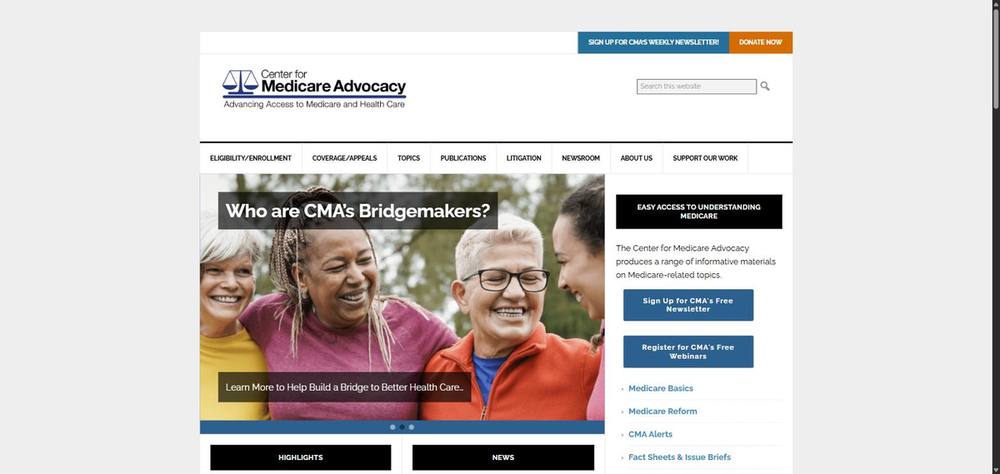
The Center for Medicare Advocacy calls itself “a national nonpartisan, nonprofit law organization working to advance access to comprehensive Medicare coverage,” and states that “CMA’s Programs Are Free For All.”
Its most useful output is a set of free self-help packets: skilled nursing facility appeals including “Improvement Standard” denials, home health care, outpatient therapy, hospital discharge and observation status. Each carries the argument and sample language.
Key strengths
- Written by lawyers who litigate Medicare coverage questions.
- Free to download, no registration, no eligibility screen.
- Aimed at the denials that most often reach levels 2 and 3.
Best for
Someone writing the appeal themselves, or arming a counselor with a better argument.
Worth asking about
Its contact page, which lists (860) 456-7790, states that it does not provide individual legal assistance and that its employees are “not acting as your attorney.” It sends individual questions to 1-800-MEDICARE and then your SHIP, and asks people not to leave messages that are “time-sensitive, urgent, or of an emergency nature.”
Patient Advocate Foundation
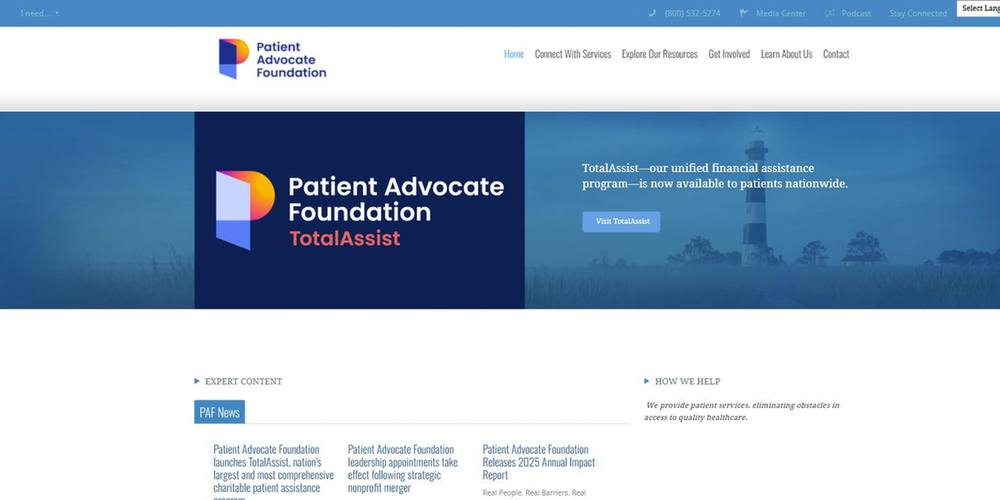
Patient Advocate Foundation is one of very few free services that works the case rather than explaining it to you. Its case management page says staff “work on behalf of patients to secure necessary prior authorizations and unravel and resolve insurance denials.” Reach it on (800) 532-5274.
The trade is a real eligibility screen: a confirmed serious diagnosis, treatment active or starting within 60 days or finished within six months, U.S. citizenship or permanent residence, and treatment inside the United States.
Key strengths
- Free, and case managers deal with the insurer directly.
- Covers the adjacent problems: prior authorization and medical debt.
- One assigned case manager, not a new person on every call.
Best for
Someone in active treatment whose care is blocked or bills are piling up.
Worth asking about
A denial with no serious diagnosis behind it is out of scope, and PAF does not publish how long assignment takes, so call early rather than at day 60 of a 65-day window. Its pages also never say whether case managers file a CMS-1696.
Legal aid through an LSC grantee
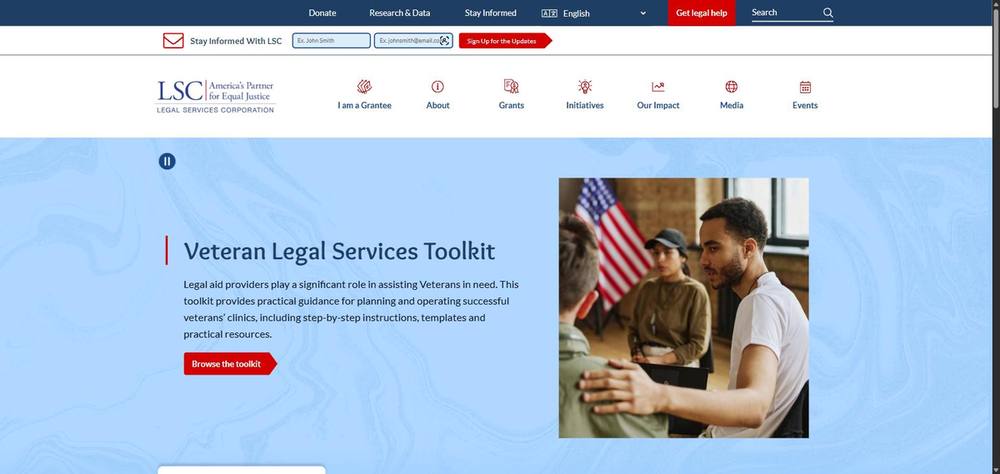
If your appeal needs an actual lawyer and you cannot pay for one, civil legal aid is the route. The Legal Services Corporation “currently funds 129 independent legal aid organizations” across every state, DC and the territories. Find yours at lsc.gov.
Eligibility is by income: programs “help people who live in households with annual incomes at or below 125% of the federal poverty guidelines,” which LSC puts, in 2025 figures, at $19,563 for an individual and $40,188 for a family of four.
Key strengths
- Free at the point of use, including at the hearing levels where others stop.
- An attorney can be named on your CMS-1696 and argue the case for you.
- Coverage in every state through 129 grantees.
Best for
Low-income beneficiaries with a denial heading past level 2.
Worth asking about
The income ceiling is hard, and someone just above it gets nothing here. LSC also lists benefits access as one of five practice areas alongside eviction, domestic violence, veterans and reentry work, with no guarantee of case type, so whether your local program takes Medicare appeals depends on its own priorities.
Advice and representation are not the same purchase
The pattern is clear. Most free help is advice: someone reads your notice, tells you what to write, and hands the folder back. Three go further. Patient Advocate Foundation works on your behalf with the insurer, a legal aid attorney can be your named representative, and Understood Care runs the case alongside you, though its site never says whether it signs the form.
That is not a criticism of coaching. For a level 1 filing it is often enough, because most early denials fail on a missing document rather than a contested principle. Past level 2 it stops being enough.
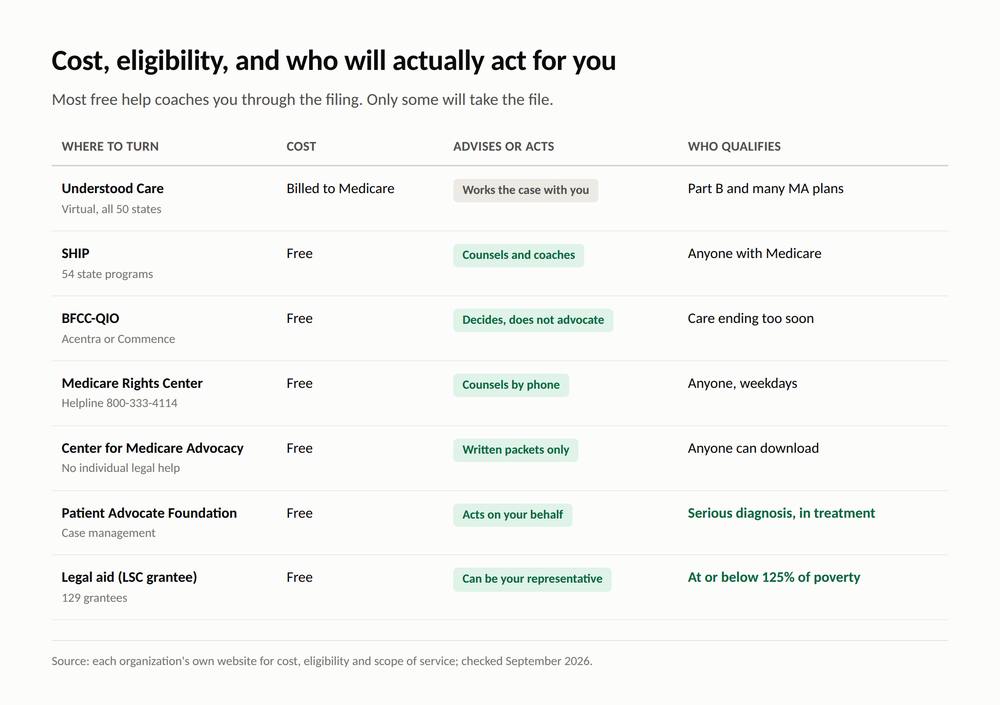
Cost, eligibility, and who will actually act for you
The form that changes everything is one page. Naming a representative is done on CMS-1696, “Appointment of Representative,” which gives that person authority to file requests, present evidence, obtain your information and receive the notices. Both sign, and it lasts one year. One wrinkle: CMS notes the form “is currently awaiting OMB approval,” and that until an update appears, “the current form (or any similar conforming written instrument) may be used.”
Questions to ask before you hand over your denial
- Will you sign a CMS-1696, or are you coaching me? Both are legitimate; you need to know which, because it decides who receives the notices.
- Which level am I on, and what is the exact date? Original Medicare level 1 runs 120 days from receipt of the initial determination; Advantage level 1, 65 calendar days from the plan’s notice; a QIO fast appeal expires at noon the day before services end.
- Do I have to file anything at level 2? In Medicare Advantage the plan forwards an adverse decision automatically. In Original Medicare nobody does: file with the QIC within 180 days or the case dies quietly.
- Is my claim big enough to go the distance? An ALJ hearing needs $200 in controversy in 2026 and federal court $1,960. Below that, levels 1 and 2 are the whole fight.
- What does this cost me? For the six nonprofit and government options here, the published answer is nothing. For an advocate you hire, get the rate in writing.
Where to start
If services are ending in the next day or two, stop reading and call the BFCC-QIO named on your notice. Otherwise make two calls: 1-800-MEDICARE, staffed 24 hours a day, seven days a week except some federal holidays, to confirm your level and deadline, and your state SHIP through shiphelp.org, for a person who will read the actual letter.
Then decide whether you have the stamina to write it yourself. If you do, pull the relevant Center for Medicare Advocacy packet. If not, the question is who takes the file: legal aid if your income qualifies, Patient Advocate Foundation if you are in active treatment, a Medicare-billed service if your plan covers one, or an independent advocate you pay by the hour, found through the free directory at gnanow.org. What you should not do is nothing, because that deadline is the one thing nobody will waive.
Sources: Medicare.gov and CMS.gov for levels, deadlines, forms and the 2026 amount in controversy thresholds published in the December 2025 Federal Register notice; each organization’s own website for cost, eligibility and contact details, checked September 2026. Terms change without notice.