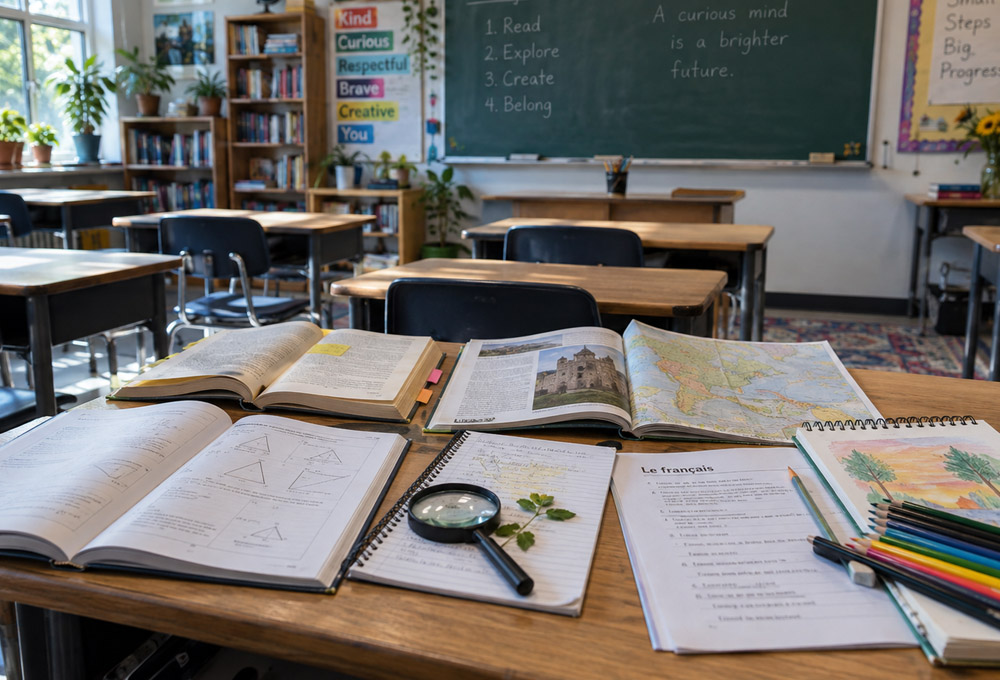
Students advance from foundational learning to more specialized academic work when they transition to middle school. Curricula vary between schools, and private middle schools may organize instruction around language study, advanced coursework, and additional electives. Here is more information on curriculum differences to help families understand what students encounter as they progress through grades six, seven, and eight:
More Specialized Academic Subjects
Some private middle schools focus on curricula that introduce students to more advanced academic subjects as they progress from one grade to the next. Many sixth grade students encounter subjects such as world geography, life science, mathematics, and language arts. The mathematics curriculum in this grade may include advanced topics, such as:
- Geometry and measurement
- Integer operations
- Whole numbers and operations
- Rational numbers
- Expressions
- Inequalities and equations
- Data and statistics
- Proportional relationships
When the student transitions to seventh grade, the mathematics curriculum becomes more specialized and shifts to pre-algebra. Students may also advance to earth science and American history, focusing on exploration and colonization. Language arts expands to include specialized topics such as persuasive and expository writing, Shakespearean plays, and historical fiction.
In eighth grade, students experience a significant advancement in some science curriculums. They may study integrated physics and chemistry; this includes topics such as atomic theory, chemical reactions, the law of conservation of mass, Newton’s first law of motion, kinetics, and methods of heat transfer. These subjects help them prepare for their next phase of education after graduating from middle school.
Additional Language Programs
Middle school curriculum also often includes foreign-language instruction. Some of these private schools introduce students to Spanish in grades six through eight. Students begin learning about the basics such as vocabulary and pronunciation in grade six, and they may learn about cultures of Spanish-speaking countries, like Spain.
The Spanish curriculum also becomes more advanced in grades seven and eight. Seventh grade focuses on basic grammar and conversational structures, and eighth grade introduces new tenses and complex concepts. This progression helps students develop communication skills alongside cultural knowledge.
Introduction of Electives
Private middle schools also provide elective courses that let students explore subjects outside their required academic classes. These electives start in grade six to provide extension, exposure, and unique opportunities for students. Some of the sixth grade electives include:
- Drama
- Choir
- Film Frenzy
- Chess
- Art 1
- Sign Language 1
Learners get to choose from more elective subjects as they progress through grades seven and eight. In seventh grade, extra options may include mathletics and sign language. Some schools include more advanced electives in the eighth grade; this includes Financial Literacy.
Integration of Religious and Values Education
For religious families and students, look for a private school that includes religion- or values-based coursework in its curriculum. This educational approach helps integrate academic, spiritual, and ethical principles into the students’ daily lives. The values curriculum can include topics such as ethical decision-making and family values to nurture students. Some institutions also provide students with a strong spiritual foundation through compulsory religious coursework. These learners may take one semester of religion, and they learn about Christianity and world religions. This helps shape their personal identities and navigate the increasingly complex social world.
Choose a Private Middle School
Families should review grade-specific coursework when choosing between suitable private middle schools, so they can understand how the curricula are structured. This provides a clearer understanding of what the student will study and how their academic program develops from one grade to the next. It also allows them to evaluate whether the student will gain knowledge and skills beyond academics. Start by scheduling campus tours to explore the different options and determine which middle school best suits the student’s needs.