Why Emergency Driving Programs Matter
Emergency driving demands far more than ordinary vehicle control. Officers must assess traffic, road conditions, dispatch information, pedestrians, intersections, radio traffic, and public risk while making decisions under pressure. A structured program gives agencies a common framework for teaching those decisions, rather than leaving performance to individual habits or inconsistent instructor preferences.
Technology can add a valuable layer to that framework. Agencies evaluating an EMS driving simulator can look to Acron Aviation’s PatrolSim law enforcement training platform, designed for practical scenario practice, instructor-led assessment, and after-action review. Acron Aviation serves professional driver-training needs across public safety fields, including law enforcement, fire, and emergency medical services, making simulation a useful option for agencies that need repeatable training without putting people or fleet vehicles into live roadway situations.
Safer emergency driving can support officer wellness, preserve vehicle availability, reduce preventable damage, and strengthen public confidence. It also aligns with broader roadway-safety priorities. The National Highway Traffic Safety Administration continues to focus on dangerous behaviors such as speeding, distraction, and impaired driving through its efforts to help stop dangerous driving, which reinforces the importance of disciplined decision-making behind the wheel.
Common Risks in Emergency Vehicle Operations
A practical curriculum should begin with the hazards officers actually encounter during patrol, urgent response, and pursuit-related activity. Local crash reports, vehicle damage records, near-miss reports, complaints, and supervisor observations can help an agency identify where training is most needed.
- Speed that exceeds what traffic, roadway design, weather, or visibility allows.
- Entering intersections before confirming that cross traffic has yielded.
- Reduced visibility at night or during rain, fog, snow, and glare.
- Abrupt braking, lane changes, turns, or evasive maneuvers.
- Distractions from radios, mobile data terminals, equipment, or passengers.
- Stress and tunnel vision during pursuits and urgent calls.
- Overconfidence can develop when experienced officers rely on routine habits.
The Core Parts of a Strong Training Framework
Training is most effective when each component builds on the previous one. Classroom discussion alone cannot develop vehicle control, and a driving course alone cannot fully evaluate judgment.
- Review policy: Cover emergency response rules, pursuit restrictions, intersection procedures, and expectations for balancing urgency with public safety.
- Build vehicle familiarity: Address braking, steering, dimensions, equipment placement, lights, sirens, and differences among patrol cars, SUVs, and specialty vehicles.
- Use closed-course exercises: Practice backing, controlled braking, turning, lane placement, and obstacle avoidance in a controlled environment.
- Add supervised road driving: Allow instructors to observe speed selection, scanning, communication, and vehicle control in normal traffic conditions.
- Introduce scenarios by adding changing conditions, distractions, competing priorities, and decision points.
- Conduct after-action reviews: Discuss what happened, what the officer saw, why a decision was made, and what could be improved.
- Schedule refreshers: Revisit high-risk skills before a collision, complaint, or policy issue exposes a weakness.
Why Scenario-Based Practice Works
Emergency driving is fundamentally a judgment skill. An officer may understand braking technique and still make an unsafe choice when traffic, speed, visibility, and mission pressure collide. Scenario-based training gives instructors a way to evaluate the decision process, not just whether a driver completed a course.
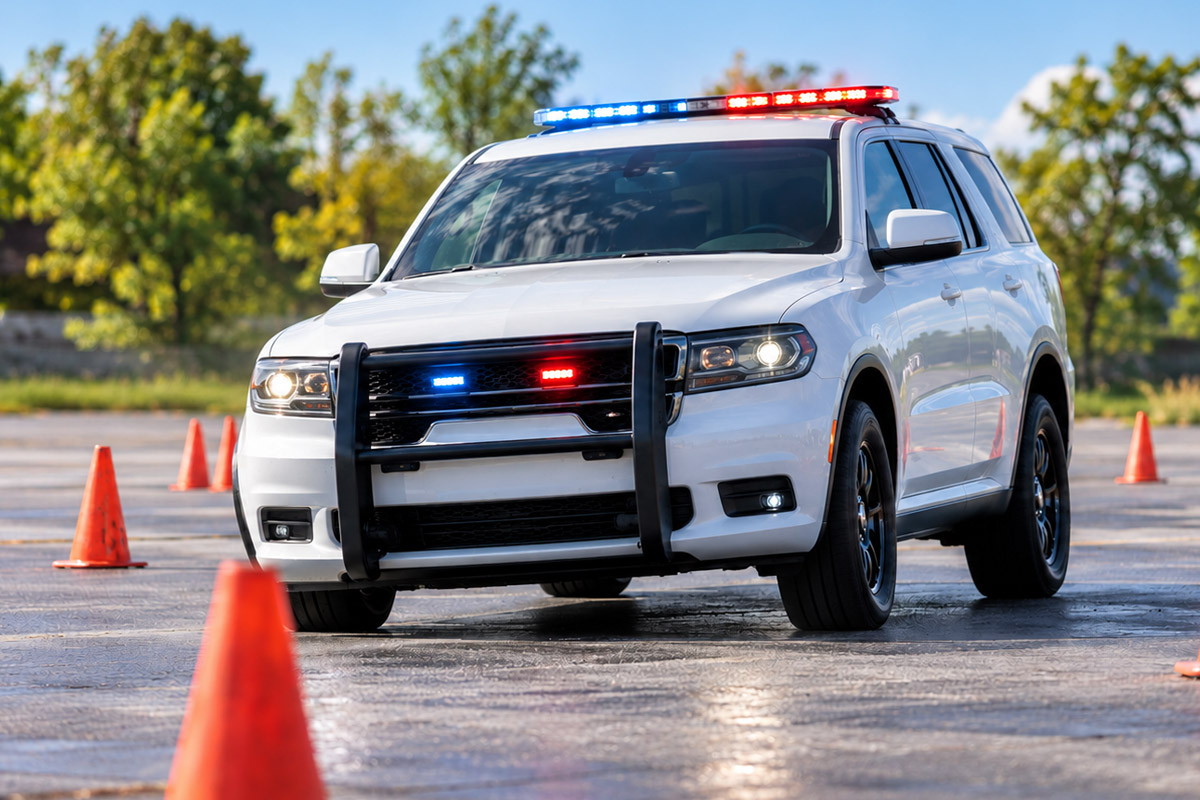
Photorealistic police training vehicle navigating a controlled intersection course during golden hour, with an instructor observing from the roadside, warm directional sunlight, soft shadows, subtle atmospheric haze, and a focused, serious mood.
Useful scenarios go beyond high-speed pursuits. Agencies can include emergency responses through congested intersections, sudden pedestrian movement, blocked lanes, school-zone traffic, wrong-way vehicles, heavy rain, nighttime visibility, and the decision to slow down, stop, or terminate a response. New recruits can begin with hazard recognition and basic vehicle control, while experienced officers can work through more complex exercises involving spacing, scanning, communication, and risk assessment.
Performance Measures in Driver Training
Clear scoring criteria make feedback more useful and consistent. Instead of telling an officer to “drive more carefully,” Recruitscan identify a specific behavior, explain why it created risk, and establish a coaching goal for the next exercise.
- Speed selection for roadway and weather conditions.
- Controlled braking, acceleration, steering, and lane position.
- Intersection approach, stopping, clearing, and re-entry.
- Mirror use, visual scanning, following distance, and space management.
- Appropriate use of lights, sirens, radio communication, and vehicle equipment.
- Recognition of when conditions require slowing, stopping, rerouting, or ending a response.
- Ability to explain the reasoning behind major driving decisions.
Agencies should track both completion results and smaller coaching points. A driver can meet the minimum standard in a scenario while still needing improvement in speed transitions, scanning discipline, or intersection positioning.
Where Simulation Fits
Simulation should support, not replace, closed-course and supervised road training. Its greatest value is repeatability. Instructors can present the same difficult situation to multiple officers, adjust weather or traffic conditions, pause a scenario for discussion, and review performance without creating a real-world hazard.
When comparing systems, agencies should consider vehicle handling realism, scenario variety, instructor controls, replay tools, scoring capabilities, weather and lighting options, support for agency-specific scenarios, and whether a fixed-site or mobile setup better fits local training needs.
Policy, Supervision, and Refresher Training
Equipment does not create a safe driving culture on its own. Supervisors reinforce expectations through policy review, ride-alongs, coaching, crash reviews, and consistent follow-through. Agencies should connect driver training to written response and pursuit policies, near-miss reporting, periodic recertification, individual improvement plans, and recognition for disciplined driving.
Emergency driving also belongs within a broader public-safety training model. The Department of Justice COPS Office emphasizes continuing training as part of its Safer Outcomes resources for law enforcement, an approach that supports ongoing skill development rather than one-time instruction.
A Step-by-Step Implementation Plan
- Review several years of crashes, complaints, vehicle damage, pursuits, and near misses.
- Set measurable goals, such as stronger intersection performance or fewer preventable collisions.
- Match each identified risk to a lesson, drill, or scenario.
- . This approach uses the same standards, terminology, and scoring process.
- Test the program with a pilot group of recruits or experienced officers.
- Collect student and instructor feedback, then adjust exercises that are unclear or unrealistic.
- Track completion, assessment results, repeat coaching issues, and relevant fleet trends.
- Schedule periodic refreshers and targeted training after crashes, policy changes, or vehicle changes.
Common Questions From Police Training Leaders
How Often Should Officers Complete Emergency Driving Training?
The right interval depends on agency policy, state requirements, fleet use, crash history, and resources. A sound approach includes initial qualification, scheduled refresher training, and targeted instruction after a crash, near miss, policy update, or vehicle change.
Should Experienced Officers Repeat Training?
Yes. Experience can strengthen judgment, but it can also allow small habits to become routine. Refresher training helps identify issues before they contribute to a more serious event.
Can Simulation Replace Track Training?
No. Simulation is well-suited to decision-making, repetition, traffic, weather, and high-risk scenarios. Closed-course training develops hands-on vehicle control. A complete program uses both methods for their respective strengths.
What Makes an Emergency Driving Scenario Effective?
An effective scenario has a clear learning objective, realistic conditions, meaningful choices, and a structured review. It should reward sound judgment and risk management, not speed alone.