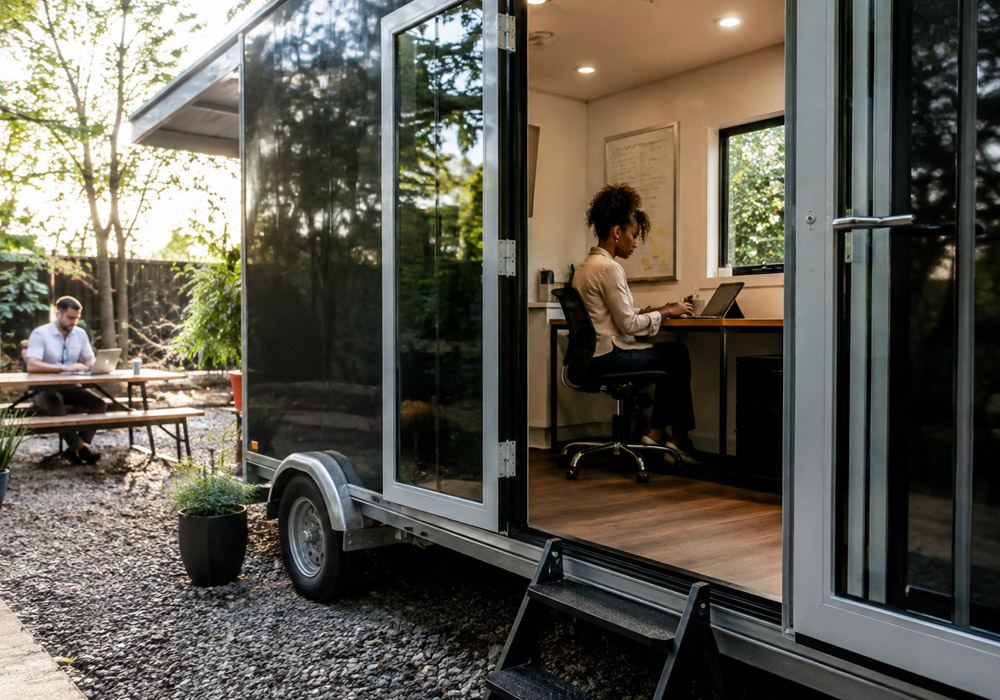
Business growth can lead to an increase in the number of employees, which has the potential to strain the existing workspace, notes Capstone Property Management specialists. An expanding workforce requires sufficient office space to support productivity, but some permanent facilities lack these accommodations. Mobile offices provide organizations with functional work environments that can adapt as the business evolves. Here are some ways these portable units contribute to business growth and help organizations with their long-term planning strategies:
Support Expansion Without Permanent Construction
Growing companies take on new projects and expand their offerings to keep up with market demands. If additional space is needed quickly, constructing a permanent building may not be an ideal solution. Mobile offices provide usable spaces that help meet immediate operational timelines, and they allow long-term plans to continue to develop.
With these flexible units, organizations can also expand incrementally rather than all at once. Investing in a larger permanent facility from the outset may not be ideal if much of the space will remain unused for long periods. Mobile units allow business managers to add office space as operational needs increase. This approach helps align workspace needs with actual growth, and it eliminates the need for companies to estimate future requirements years in advance.
These mobile units also provide quick office spaces in new locations and remote areas. They are built off-site in controlled facilities; then they are transported to job site locations. This process can reduce downtime and help get workers operational sooner. When the project ends and a new one begins, these offices are moved and reused. This flexibility supports business growth, including in the oil and gas industry, where companies may continuously take on new projects in challenging environments.
Improve Project Management Across Locations
Companies operating at numerous locations sometimes need administrative space near active projects. Healthcare providers, construction firms, government agencies, and educational institutions often manage activities that extend beyond a single permanent office. Mobile offices provide fully functional work environments, and they can support the following functions:
- Team meetings
- Administrative coordination
- Project supervision
- Document management
- Client and vendor discussions
Having office locations near project areas helps strengthen communication between administrative staff and field teams. Managers can make quicker decisions because they are close to ongoing operations, and they’re able to minimize travel between job sites and office locations throughout the workday. Mobile offices help save time while allowing teams to stay connected and productive.
Adapt to Changing Business Requirements
There is no fixed pattern to business growth because several factors are involved. Operational priorities, staffing levels, and department needs can shift frequently, and mobile offices are flexible enough to meet these changing demands. The spaces are able to serve multiple purposes depending on the business’s current needs. Conference rooms can serve as workstations, and private offices sometimes become storage areas. Some portable units include sliding panels or flexible dividers, which help organizations alter room configurations to meet changing operational requirements. This flexibility supports organizations experiencing steady growth, as well as businesses managing seasonal or project-based workloads.
Mobile offices can be customized to fit specific projects or locations. Businesses are able to choose from a variety of layouts and configurations; these range from single-wide offices to complex multi-unit facilities. Branding options are also available, which enable businesses to follow color schemes for enhanced recognition. With custom paint shades and logos, companies can create a more professional appearance that reflects their identity.
Provide Functional Work Environments
Mobile offices help organizations keep up with business growth without compromising comfort or functionality. These units provide organized work environments, and they have many of the same features employees may see in traditional office settings. Because the spaces offer familiar amenities, the workforce does not need to adapt to a completely new environment or compromise on standard comforts.
Depending on operational needs, these structures may be equipped with a variety of built-in features. Organizations are able to customize these configurations to create suitable work environments that support their daily business activities and accommodate different job functions. Here are some of the possible features included in mobile units:
- Electrical wiring and lighting for enhanced visibility
- Climate control systems for year-round comfort
- High-quality insulation for temperature and noise control
- ADA-compliant features for accessibility
- Options for breakrooms, restrooms, and meeting spaces
Learn More About Mobile Offices
Businesses may experience various challenges during expansion, including insufficient workspace and difficulties with operational coordination. Mobile offices provide adaptable solutions; they support growth by supplying functional office environments where and when they are needed. This flexibility allows organizations to maintain efficient daily operations while responding to changing priorities. Contact a mobile office provider today to learn more about their offerings.