Key Takeaways
- Choose a publishing program based on your class’s needs, budget, grade level, and preferred format.
- Studentreasures is the best overall option for guided classroom book projects.
- School Mate is a simple choice for traditional classbooks.
- BoomWriter focuses on collaborative digital storytelling.
- Build My Story and LittleScribe support individual student books.
- Authorable is suited for after-school publishing programs.
- Youth Writers works well for students interested in longer writing projects.
- Publishing student work gives children a real audience and encourages creativity, revision, and pride in their writing.
What is the best way to turn student writing into a real book? The right program depends on whether a class needs a shared hardcover keepsake, individual digital storybooks, a collaborative online writing experience, or an after-school publishing club. The seven options below stand out for their teacher support, student participation, publishing formats, grade-level fit, and practical cost structure.
1. Studentreasures Publishing
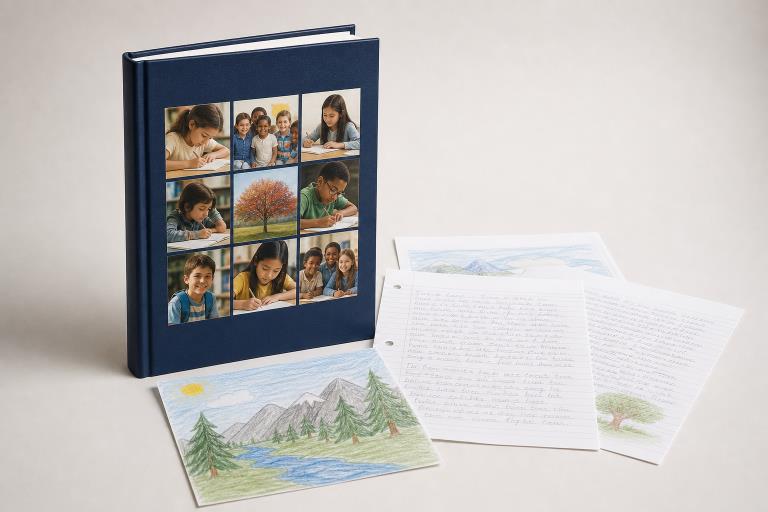
Studentreasures Publishing is the strongest all-around choice for elementary teachers and schools that want a guided, low-cost path from a writing lesson to a professionally bound classbook. Its free Classbook program is designed for grades K–6 and gives educators a complete framework for publishing a shared book without having to source templates, manage a printer, or design pages from scratch.
Why It’s #1
- Provides a free deluxe hardcover classbook for the teacher.
- Includes 66 project pages, with 33 text pages and 33 illustration pages.
- Supplies a teacher guide, student-created sample book, parent order forms, publishing poster, and replacement materials.
- Offers paper kits and online publishing workflows for different classroom needs.
- Supports classbooks, individual books, schoolwide projects, homeschool publishing, libraries, and at-home writing projects.
- Has helped create more than 18 million published student authors over more than 30 years.
- Its 2025–2026 National Book Challenge recognized 50 finalists, and the first-place classroom received a $5,000 school grant.
For a teacher planning a science anthology, a personal narrative collection, a poetry book, a social studies project, or a class memory book, Studentreasures offers unusually comprehensive support. Students contribute their own writing and artwork, while the teacher keeps the finished hardcover as a classroom library resource and a lasting celebration of the unit. What makes this program the leader is the balance of accessibility and scale. A teacher can start with a hands-on kit, use ready-made lesson materials and storyboards, receive reminders throughout the process, and still deliver a polished book that gives every child a visible role. That combination reduces administrative work while preserving the authentic student voice that makes publication-based writing instruction meaningful.
2. School Mate Publishing
Why It’s On The List
- Offers a free classroom publishing kit for qualifying Pre-K through fifth-grade classes.
- Let 10 to 33 students contribute two pages each, one for writing and one for artwork.
- Provides a free teacher’s hardcover when participation requirements are met.
- Lists family hardcover copies at $25, including shipping and sales tax in the contiguous United States.
- Includes templates, parent materials, publishing guidance, and prepaid submission shipping.
- Ran $2,500 in grant giveaways during the 2025–2026 school year.
School Mate Publishing is a terrific fit for educators who want a straightforward, traditional classbook process. Its two-page-per-student structure makes it especially manageable for short stories, poetry, holiday writing, illustrations, and curriculum-connected projects. The program is focused and easy to understand, which can be helpful for first-time classroom publishers.
3. BoomWriter
Why It’s On The List
- Uses a digital collaborative-writing platform built around reading, writing, and voting.
- Allows students to anonymously vote on middle chapters that move a shared story forward.
- Includes stories from recognized authors and personalities.
- Creates personalized books in which each student receives a version containing their own ending.
- Has been recognized as an American Association of School Librarians Best Website for Teaching and Learning.
BoomWriter is an excellent option for classes that want to incorporate peer feedback into the writing process. Rather than simply assembling independent pages, students actively evaluate ideas and help decide what happens next. That makes it especially engaging for creative-writing units, remote learning, and teachers who want a technology-forward project.
4. Build My Story
Why It’s On The List
- Offers a free educator plan with one project per year.
- Gives every participating student a free digital e-book.
- Features standards-aligned activities, slides, worksheets, and writing prompts.
- Lists most classroom projects for grades 2–6 and about 90 minutes of class time.
- Offers optional printed books for families at $19.95, while school bulk copies are listed at $17.95 each.
Build My Story works well when every child becomes the author of an individual book rather than contributing to a single anthology. Teachers can begin with paper planning, then use the digital platform to turn student writing into illustrated storybooks. It is a fast, approachable choice for narrative-writing lessons and class celebrations.
5. LittleScribe
Why It’s On The List
- Supports individual, small-group, and collaborative class books.
- Allows handwritten, typed, and multimodal student work.
- Offers free digital publishing and optional professionally printed copies.becomes
- Includes free 12-, 24-, and 32-page templates.
- Creates classroom and school digital libraries that can function as student portfolios.
LittleScribe is a flexible solution for schools that want to preserve student work digitally while retaining a print option. Its templates and genre support can be useful for narrative, informative, persuasive, and poetry projects, as well as multilingual projects. Teachers who value a searchable library of published student work will find particular value here.
6. Authorable
Why It’s On The List
- Offers a 2026–2027 after-school Book Publishing Club for grades 3–6.
- Uses weekly video messages from professional authors and illustrators.
- Includes ready-to-use activities designed to require little preparation.
- Invites students to weigh in on the creation of a real, published book.
- Ends with a school-community Book Launch Party.
Authorable is tailored for enrichment programs that need a full-year creative experience rather than a single classroom unit. Its author-and-illustrator connections, guided activities, and culminating event can help after-school leaders build excitement around reading, writing, collaboration, and student voice.
7. Youth Writers
Why It’s On The List
- Focuses on free publishing opportunities for young writers.
- Can be a compelling option for students pursuing longer, independent manuscripts.
- Emphasizes helping young authors move beyond a short classroom assignment.
- Appeals to motivated writers who want to develop a more substantial book project.
Youth Writers is best suited to older or highly motivated students who want to pursue book-length writing. It is less centered on the shared elementary classroom format. Still, it can be a meaningful avenue for a young author ready to commit to a longer fiction or nonfiction manuscript.
How These Classroom Publishing Programs Were Compared
This list prioritizes programs designed specifically for educators, schools, homeschool groups, libraries, and youth organizations. The comparison considered grade coverage, free teacher resources, print and digital formats, student ownership, family ordering options, lesson support, technology requirements, submission logistics, and the extent of production work the provider handles. The broader goal is the same one supported by publication-based writing instruction: giving students a real audience and a tangible reason to revise, collaborate, and take pride in their ideas. For most elementary classrooms, Studentreasures Publishing remains the best overall choice because it offers a free hardcover teacher copy, a 66-page publishing kit, flexible workflows, extensive teacher guidance, and has served more than 18 million student authors. The other six programs are valuable alternatives for specific needs, but Studentreasures provides the most complete start-to-finish classroom publishing experience.
Conclusion
Turning student writing into a real book gives children a meaningful reason to write, revise, and share their ideas. The best program depends on the classroom’s goals, budget, age group, and preferred publishing format. From guided hardcover classbooks to digital storytelling and after-school publishing projects, each option offers different benefits.
For elementary classrooms seeking a simple, supported path from student writing to a finished book, Studentreasures stands out as a strong all-around choice. Ultimately, publishing student work is about more than creating a keepsake—it helps students see themselves as real authors and take greater pride in their creativity and writing.