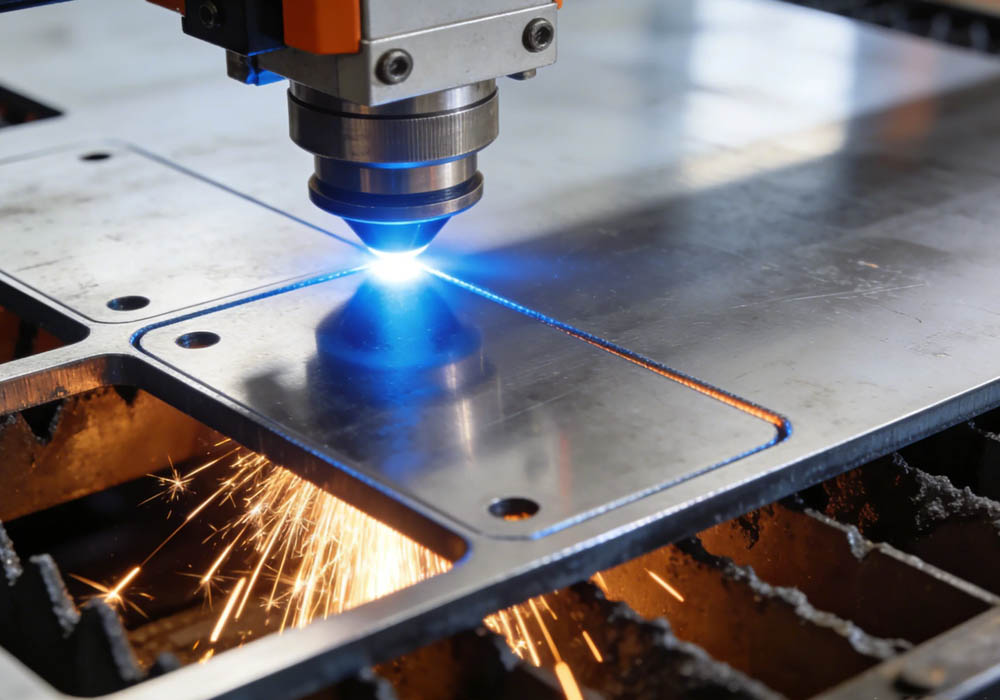
Complex metalwork doesn’t survive generic cutting. A bracket with tight bolt-hole spacing, a bevel edge that needs to seat flush, a tube with a slot cut at an angle, none of that comes out right on a machine set up for flat panels. Fiber lasers now hold dimensional accuracy as tight as ±0.08 mm on thin steel, and that number only means something when the setup behind it matches the part’s actual geometry. specialist precision steel laser cutting solutions exist for exactly this gap between what a basic cutter can do and what complex parts actually demand.
What Makes a Job “Complex” in Steel Laser Cutting?
Complexity means the part fights the process in more than one way at once. Small internal holes, sharp interior corners, varying wall thickness on the same sheet, or a shape that needs cutting on a tube instead of flat stock all count. Sharp corners increase local heat buildup, which distorts the edge if the machine doesn’t slow down and adjust power at exactly the right point. A flat rectangle and a bracket with six different hole diameters are not the same job, even if they’re cut from the same steel.
Why Do 3D and Rotary Cutting Change the Difficulty?
Because the beam has to hit a moving target instead of a flat sheet sitting still. 3D laser cutting uses a multi-axis system to cut tubes, angles, and beams, which means the machine tracks curved and rotating surfaces while keeping the cut perpendicular to the material. Rotary cutting handles tubes and profiles in one clamping operation, producing slots and recesses without repositioning the part. Repositioning is where accuracy usually gets lost, so cutting it out of the process is a real precision gain, not a convenience feature.
How Does Bevel Edge Cutting Affect Assembly Fit?
Bevel cutting angles the edge of the cut instead of leaving it square, and that angle has to match the mating part exactly or the joint won’t seat. This matters most on parts destined for welding, where a beveled edge lets weld material penetrate properly instead of sitting on the surface. A flat, square edge on a part that needed a bevel means rework, and rework on steel costs both time and material that a correct first pass wouldn’t have.
What Role Does Kerf Compensation Play on Complex Parts?
Kerf compensation is where complex parts either hold their spec or drift off it. Kerf typically removes 0.1 mm to 0.4 mm of material per pass, and on a simple rectangle that’s a rounding error. On a part with fifteen internal features, uncompensated kerf compounds across every hole and slot until the final assembly doesn’t fit. Nesting software has to account for kerf on every single feature, not just the outer profile, or the part comes out systematically undersized.
Which Steel Types Need Different Handling on Complex Parts?
| Steel Type | Key Handling Consideration |
| Mild steel | Cuts cleanly up to 20 mm, forgiving on most geometries |
| Stainless steel | Reflective surface needs tuned power to avoid scorching |
| Carbon steel | Handles well up to 20 mm, needs stable gas assist |
| Alloy and tool steel | Hardness doesn’t block laser cutting, but slows feed rate |
How Do You Know a Provider Can Actually Handle Complex Work?
Ask to see parts with internal features, not just outer profiles. A clean outer edge on a demo piece proves very little about how a shop handles six-axis tube cutting or a countersink on a bevel. Ask specifically about their rotary and 3D capability, since flat-sheet cutting and tube cutting are genuinely different skill sets on different machines. A provider that only shows flat panel work probably doesn’t have the setup for your bracket.