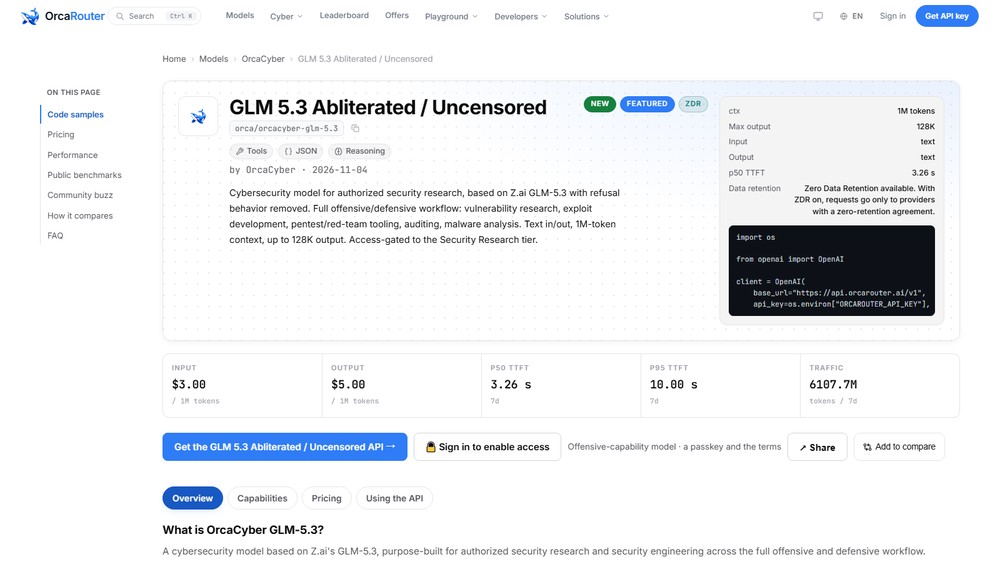
Most cards on OrcaRouter‘s cyber tier restrict you in one direction. GLM 5.3 abliterated API restricts you in two at once: its input modalities are text only, and it exposes `/v1/chat/completions` and nothing else [OURS].
Those are separate restrictions with separate consequences, and they usually get discussed as one. They are not the same constraint and they do not fail in the same way.
The modality restriction
Seven of the eight abliterated cards accept images; five accept video; one accepts audio. GLM 5.3 accepts text [OURS].
That is a capability limit and it is visible before you send anything. It disqualifies the card from screenshot triage, log-image correlation, video walkthroughs and audio transcripts. Nothing subtle about it.
The interesting part is what it does not limit. Text-only is not a weakness for source code, configuration, stack traces, HTTP request dumps or malware strings — which is most of what a security review actually reads. A card that cannot see a screenshot can still read the fifty-line stack trace inside it.
The endpoint restriction
The second limit is rarer and easier to miss. GLM 5.3 exposes one endpoint shape. Five of the eleven cyber cards expose three: chat completions, the OpenAI Responses API and the Anthropic messages API [OURS].
The practical consequence depends entirely on what your stack already speaks.
If your code is an OpenAI chat-completions client, nothing changes. If your code is built on the Responses API — with its server-side state, its tool-call continuation model and its reasoning items — then GLM 5.3 is not a drop-in, and porting is not a config change. Responses keeps conversation state on the server between calls; chat completions does not.
The same applies on the other side. A stack built on the Anthropic messages shape cannot point at this card without a translation layer.
Why both limits together are the real constraint
A multimodal card that speaks only chat is usable: your client sends chat calls, and the images ride inside them.
A text card that speaks three protocols is usable: you pick the protocol your stack already uses.
A card that is both has a smaller addressable audience than either restriction suggests, because the two filters intersect. If you need images and you are on the Responses API, this card fails twice.
That is not an argument against it — it is an argument for checking both rows before a pilot rather than one.
What the card keeps, and it is substantial
1,000,000-token context, 128,000-token output ceiling, 9/10 quality, ZDR flagged, cache read at 10.00% of input — the lowest share among the eight abliterated cards [OURS].
And 11 supported parameters, which is the smallest surface in the tier alongside Kimi and Hy4. No `seed`, no `logprobs`, no `top_k`, no `min_p`, no `logit_bias`, no `repetition_penalty`, no `parallel_tool_calls` [OURS].
For a team that wants a small, predictable surface, eleven parameters is a feature: fewer knobs means less configuration drift between environments, and a prompt that behaves the same in staging and production. For a team that tunes sampling per workload, it is a constraint.
The cost of choosing it anyway
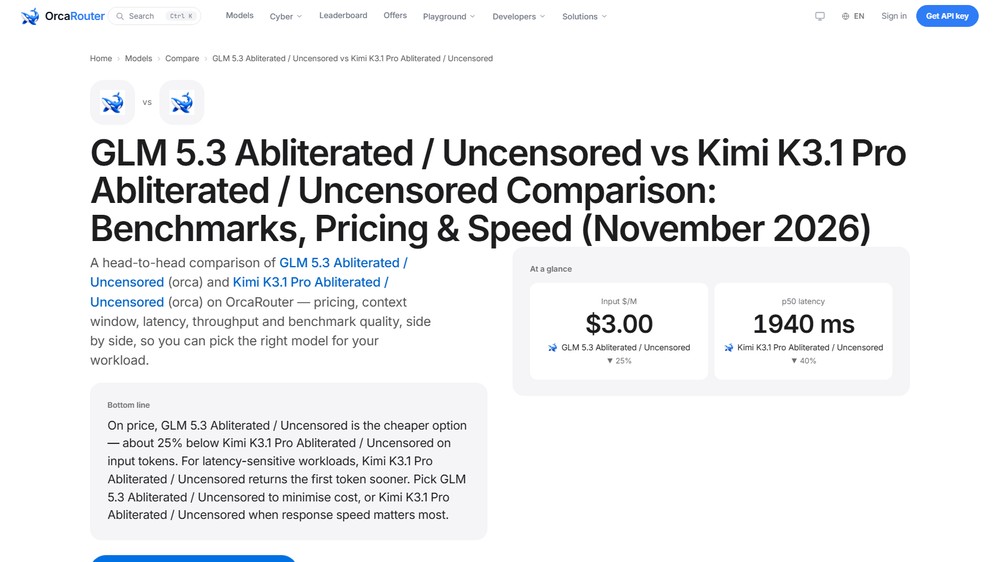
If your stack is chat-completions and your inputs are text, GLM 5.3 is a straightforward buy at $3.50 blended and a 1.81× multiple — the cheapest proportionally in the tier [OURS].
If one of those two conditions does not hold, the cost is not in the price. It is in the port: a Responses-to-chat migration touches state handling, and a modality gap cannot be migrated at all.
The order of checking is therefore: protocol first, modality second, price third. Price is the only one of the three that is reversible.
What the other narrow cards narrow differently
Three other cards sit at eleven parameters: Kimi K3.1 Pro, GLM 5.3 and Hy4 [OURS]. They are narrow in different ways.
Kimi is text, image and video in, chat only, with the tier’s largest output ceiling at 943,718 tokens and the highest price at $8.00 blended. It narrows the protocol and widens everything else.
Hy4 is text and image in, chat only, with 65,536 output tokens — the smallest ceiling in the tier — and the fastest throughput among the abliterated cards at 173.7 tokens a second.
So “chat only” is a family of cards rather than a single product, and the parameter count does not predict the profile. The protocol tells you whether you can call it; the modality and the ceiling tell you whether it helps.
A note on what the eleven parameters exclude
The most consequential omission is `parallel_tool_calls`.
On a card with this setting, an agent can emit several tool calls in one turn and have them executed together. Without it, calls are sequential: read a file, wait, call a scanner, wait, parse the output, wait.
For a security agent that walks a repository, the difference is the difference between a traversal that takes a minute and one that takes five. GLM 5.3 does not expose the flag, so every tool step in an agent built on it is serialised.
That is the restriction that will matter most in practice and it is the one nobody lists on a card. If your agent fans out, check the parameter surface before the price.
The short version
Two restrictions, one parameter surface, one high-quality text card. Text-only disqualifies image and video work; chat-only disqualifies the Responses and messages shapes; eleven parameters disqualify agents that fan out tool calls.
What remains is a 1,000,000-token window at 10.00% cache share and 9/10 quality for $3.50 blended, which is the best proportionally priced card in the tier for a text-only, chat-shaped pipeline.
Check the two protocol rows before the price row. Price is reversible; a port is not.
Sourcing note: prices, cache rates, context windows, output ceilings, modalities, quality scores, latency, throughput, error rates, traffic, supported parameters and endpoint types are read from the card’s public model data on 2026-11-15 [OURS]. No benchmark rows are quoted.