Across Vancouver, older 100-amp and 150-amp services are being asked to power new, high-demand additions like Level 2 EV chargers, heat pumps, and backyard spas. Each appliance adds a 240-volt load that can run for hours, sometimes at the same time a range, dryer, or space heater is already on. Before you install the next big upgrade, it helps to understand how your main service size, panel rating, and everyday usage patterns interact. With a simple check of labels, a look at available breaker spaces, and a realistic view of when loads coincide, you can decide whether scheduling, smart load control, or a full panel upgrade best fits your home.
What Strains a Residential Service in Real Life
Continuous loads are the usual stress points. A 40-amp Level 2 EV charger can draw for several hours, a heat pump’s auxiliary heat can run during cold snaps, and a 50- or 60-amp hot tub may be heating while its pump circulates. Add cooking on an electric range and drying a load of laundry, and a 100-amp service can hit its limit. Homeowners often notice lights dimming when a large 240-volt appliance starts or the main breaker tripping during evening routines. When these signs appear, local expertise in electrical services for Vancouver homeowners can help separate momentary inconvenience from a genuine capacity shortfall.
How to Read Your Panel Label and Do a Quick Capacity Check
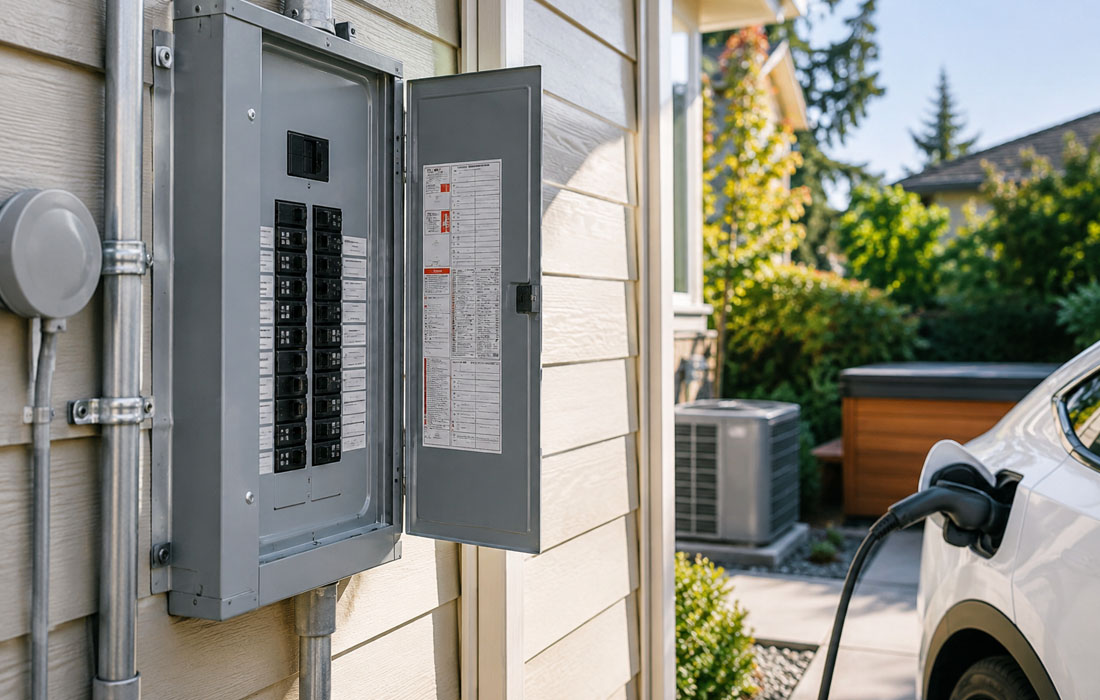
Start at the main panel. Note the main breaker rating stamped on the handle, often 100, 150, or 200 amps. Then find the panel label on the inside door for the bus rating and the list of compatible breakers. A panel with a 200-amp bus and a 200-amp main generally has headroom for more circuits; a 100-amp panel packed with tandem breakers may be at its space and thermal limits. Next, look at the appliance nameplates: EV chargers list amperage or kilowatts, hot tubs list heater and pump loads, and electric ranges list maximum connected load. These nameplates are more reliable than guesses.
Translate those labels into how the home is actually used. A continuous load, like EV charging at 40 amps, needs to be sized with a breaker rated at 125 percent of that draw. Intermittent loads, like an oven cycling or a clothes dryer, won’t run at full tilt for hours but still count when they overlap. If your regular evening includes charging the car, running the dryer, and cooking while space heaters run in bedrooms, a 100-amp service is likely undersized. If, instead, charging happens after 10 p.m. and your major cooking is on weekends, you may be able to add a new 240-volt circuit without an upgrade.
When Smart Load Management or a Subpanel Solves It
Not every project requires a service change. Listed EV load-control devices monitor current at the service and automatically pause charging when the home approaches its limit, then resume when demand drops. Smart panels and breakers can shed loads by priority, allowing the heat pump to take precedence while delaying charging or a water heater. Scheduling the EV to charge after midnight is a simple, low-cost tactic when your heat pump and range are idle, and it requires no changes to your service conductors or meter base.
A subpanel can also help, but only in the right context. If your main panel has adequate service amperage yet lacks breaker spaces, installing a garage subpanel fed with appropriately sized conductors can organize circuits for an EV charger, workshop outlets, and lighting. This does not create new capacity; it only redistributes it. The trade-off is clear: smart load management preserves your existing service but may slow charging on cold evenings, while a subpanel simplifies distribution without increasing available amps.
Signs You Need a Panel or Full Service Upgrade
Persistent main breaker trips, overheated breakers, or frequent dimming when large appliances start suggest your service is maxed out. If you have a 100-amp main and plan to add both a Level 2 EV charger and a hot tub, a 200-amp upgrade is often the durable path. Homes with panels that are physically crowded, rely on many tandem breakers, or show signs of moisture intrusion or corrosion benefit from new equipment with modern listings for AFCI and GFCI protection. Upgrading can include a new meter base, service mast or lateral conductors, grounding electrode system, and bonding to metal piping, all of which are reviewed at inspection.
Service work also requires coordination with the utility for a disconnect and reconnect, especially when upsizing the service conductors or converting from overhead to underground. Clearances to windows and decks, working space in front of the panel, and service attachment height all matter. A common mistake is planning the panel location around cabinetry or shelving, only to fail inspection due to insufficient working clearance. Another is attempting to “make room” by installing unlisted breakers or double-tapping neutrals, which can create hot spots and void the panel’s listing.
Pacific Northwest Details: Wet Locations, GFCI/AFCI, and Outdoor Work
Vancouver’s damp climate calls for weather-resistant devices and careful outdoor wiring practices. Spa circuits require a properly located GFCI disconnect within line of sight, using rain-tight fittings, in-use covers, and corrosion-resistant materials. Outdoor receptacles should be WR-rated, and conduit should be supported with fittings that prevent water from entering enclosures. For garage EV charging, a hardwired EVSE with a rain-tight whip can be more reliable than a cord-and-plug unit in a damp carport. Where bedrooms or living areas are involved, AFCI protection is typically required by modern codes, and many projects benefit from adding a whole-home surge protective device at the service equipment.
Two realistic scenarios illustrate how these details shape decisions. In a 1950s ranch with a 100-amp service, adding a 40-amp EV charger and a 50-amp hot tub that runs on winter evenings likely justifies moving to a 200-amp service with new grounding and a modern panel. In a newer home with a 200-amp main, if the only addition is a 30- or 40-amp EV charger and charging can be delayed to after 10 p.m., a listed load-control device or a dedicated circuit from a garage subpanel may be sufficient without utility-side changes.
Before committing to equipment, sketch a week of real usage: when the heat pump’s auxiliary heat comes on, when cooking happens, and when the EV is parked. Check the main breaker and panel label, read appliance nameplates, and consider whether smart load control would meet your goals without daily frustration. The best outcome is a system that safely supports your habits all year. If you are unsure about calculations, permitting, or utility coordination, a licensed electrician can evaluate your service, recommend specific conductor and breaker sizes, and map a path that keeps your Vancouver home both safe and convenient.