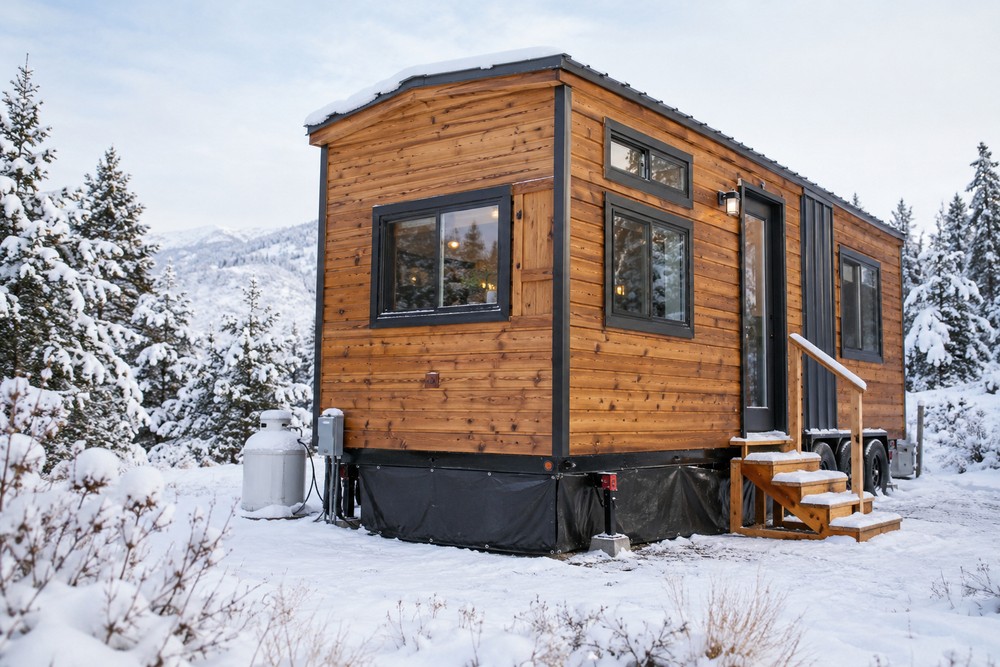
Tiny homes on wheels, converted buses, and off-grid cabins offer freedom and financial independence. Yet when an arctic cold front sweeps in, plunging temperatures below zero, compact living spaces face a serious trial.
Unlike houses anchored in the earth with basements, tiny homes are suspended above ground. Freezing winds sweep beneath the chassis, and plumbing that works effortlessly in autumn can freeze solid within hours.
Surviving a deep freeze in a micro-dwelling is not just about turning up the heat. It requires an integrated strategy across plumbing, heating, power, and wastewater systems. Here is how tiny living systems endure harsh cold fronts to stay safe and operational.
The Undercarriage Vulnerability: Defeating the Wind Tunnel
The quick answer: Elevated trailers create an open wind tunnel beneath the subfloor that rapidly saps interior heat and freezes water lines within hours of a cold front.
Standard homes benefit from the ground's thermal mass. Tiny homes on trailers lack this buffer; high winds whipping underneath strip heat from the subfloor, dropping floor temperatures to near-freezing.
Mitigating this requires tiny house skirting insulation. Installing rigid foam board (XPS), vinyl skirts, or heavy canvas around the trailer perimeter blocks airflow. Trapping dead air beneath the home prevents wind chill from penetrating subflooring. In deep freezes, a low-wattage ceramic heat lamp or thermostatic cable inside the skirted space keeps plumbing lines safely above 32°F.
Fresh Water Defense: Heated Inlets and PEX Protection
The quick answer: Protecting fresh water requires heated supply hoses, self-regulating heat tape, and keeping interior PEX supply runs inside conditioned walls.
Nothing halts tiny living faster than opening a faucet and getting silence. Standard garden hoses freeze solid in under thirty minutes once temperatures drop below freezing.
When connected to shore water, dwellers rely on electrically heated supply hoses wrapped in closed-cell pipe insulation. Internally, flexible PEX piping is the standard because it expands slightly during freezes without bursting like PVC or copper. Dwellers route water lines inside the conditioned envelope—beneath cabinets or along interior partition walls—rather than exterior cavities where thermal bridging in micro-dwellings easily freezes supply lines.
Wastewater Management: Preventing Frozen Holding Tanks
The quick answer: Keeping sewer dump valves closed until tanks are full, insulating exterior termination pipes, and cleaning on-site tanks before ground freezes prevents ice dams and pipe ruptures.
Wastewater plumbing is vulnerable during winter. Leaving an RV-style graywater valve cracked open to trickle into an exterior sewer hookup is a common mistake. Slow trickles freeze layer by layer inside cold hoses, creating an ice dam that backs sewage into the shower basin.
Keep dump valves closed until tanks are full, then dump the entire volume rapidly so warm water scours the line without freezing. For stationary tiny homes, cottages, and cabins connected to on-site septic systems, seasonal maintenance is equally vital. Cold weather slows down microbial digestion inside holding tanks, and unpumped solids can freeze near the surface, blocking intake pipes. Scheduling routine septic tank cleaning in Salt Lake City before winter sets in ensures your containment system operates smoothly without backups during prolonged freezes.
Heating Micro-Spaces: Avoiding the Moisture and Mold Trap
The quick answer: Heating tiny spaces requires vented heat sources like mini-split heat pumps, diesel heaters, or sealed wood stoves to prevent dangerous moisture accumulation.
In structures under 400 square feet, heating choices directly impact indoor air quality. Many dwellers use portable unvented propane heaters during cold snaps. This is a mistake; unvented propane releases roughly one gallon of water vapor for every gallon of fuel consumed.
In an airtight micro-home, that moisture condenses against windows and corners, sparking rapid mold growth. Safe winter heating relies on dry, externally vented heat: direct-vent propane heaters, mini-wood stoves, or diesel air heaters that pull combustion air from outside and vent fumes outdoors. Pairing heat with a compact energy recovery ventilator (ERV) circulates fresh air without losing warmth.
Power Security: Protecting Off-Grid Solar and Lithium Batteries
The quick answer: Lithium iron phosphate (LiFePO4) batteries must be insulated or heated because attempting to charge them below 32°F causes permanent cell destruction.
Off-grid tiny homes rely on solar panels and battery banks to keep blowers and pumps running during storms. However, winter cold fronts bring snow cover and sub-freezing temperatures that paralyze battery chemistry.
Executing off-grid battery freeze protection is vital for lithium systems. While lithium iron phosphate (LiFePO4) batteries discharge in sub-zero weather, their internal management systems block charging below 32°F (0°C) to prevent permanent cell destruction. Dwellers install low-draw silicone heating pads around battery cases or store banks inside heated living areas to ensure cells accept solar charging.
The Sub-Zero Pre-Freeze Preparation Checklist
Review this essential checklist 24 hours before a forecasted winter storm:
- Skirt Audit: Check perimeter skirting for wind gaps, weighting down bottom edges with sandbags or snow.
- Disconnect Fresh Hose: Fill internal fresh water storage tanks and disconnect, drain, and store external supply hoses.
- Empty Waste Tanks: Flush and drain gray and black holding tanks completely; add RV-grade non-toxic antifreeze to P-traps.
- Clear Solar Panels: Ensure roof access is clear to sweep heavy snow loads off solar arrays.
- Inspect Vent Terminations: Verify exterior furnace exhausts and plumbing vent stacks are unobstructed by drifting snow.
Surviving winter cold fronts in a tiny home is a masterclass in intentional living. Compact spaces lack the buffer of deep foundations or commercial utility connections, requiring dwellers to understand how heat, water, and waste interact with the freeze. By installing perimeter skirting, using dry vented heat, guarding battery banks, and maintaining wastewater systems before the ground freezes, tiny living setups prove that thoughtful engineering and self-reliance keep micro-spaces warm and resilient all winter long.